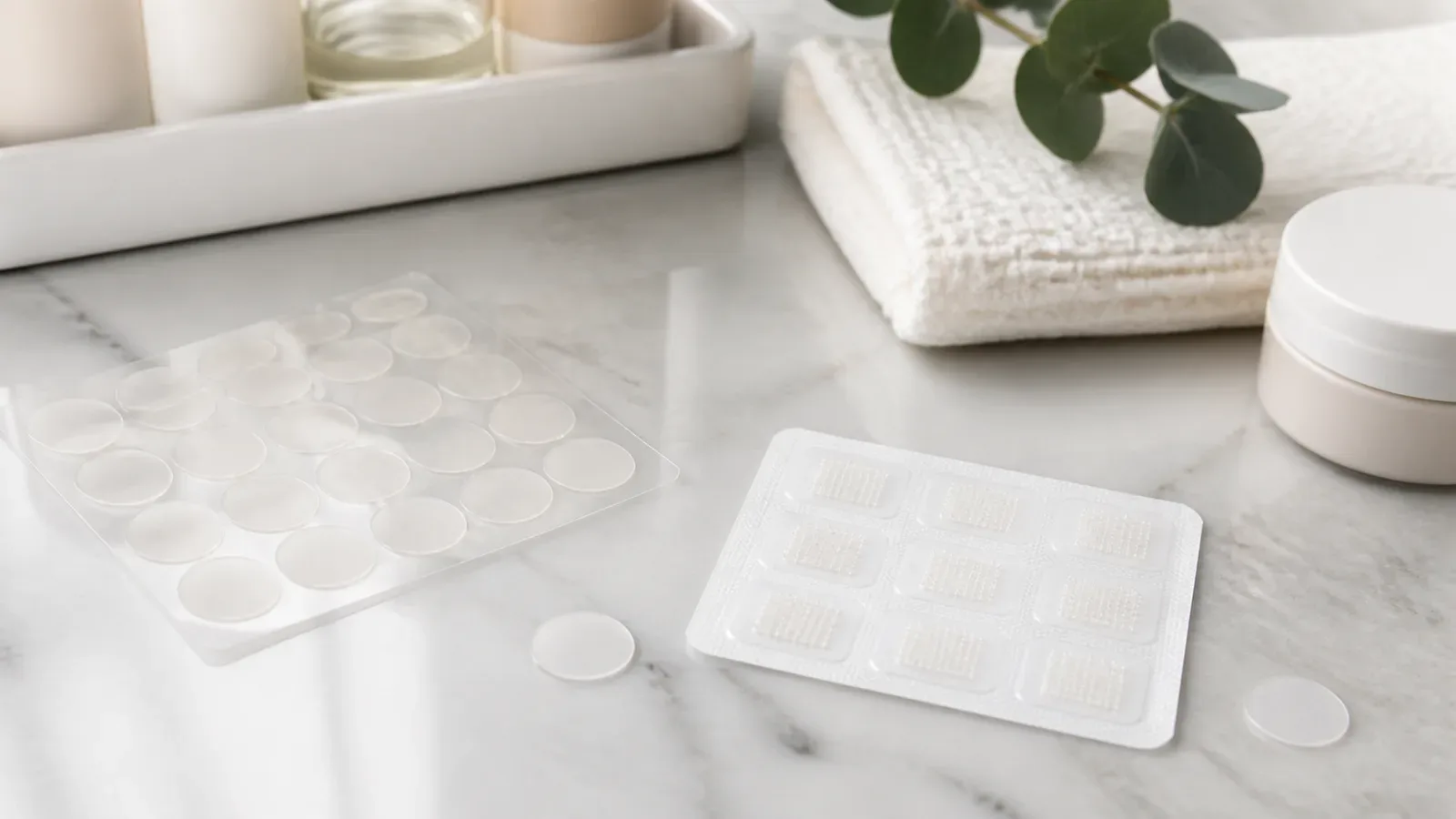
Pimple patches now come in two very different forms that often share the same shelf: plain hydrocolloid stickers and patches fitted with tiny dissolving projections, commonly marketed as microdart or microneedle patches. They are not interchangeable, and neither is a universal acne treatment. The most useful choice depends on whether a blemish is at the surface, whether it has been opened, and whether it is a deep, painful bump.
The short answer
Choose a plain hydrocolloid patch for a superficial whitehead or a spot that is already draining. Its main job is to cover the area, absorb fluid, and discourage touching. Consider a microdart patch only for an intact, early bump when you want a product designed to place cosmetic ingredients closer to the surface. Evidence and formulas vary, so read the ingredient list and do not assume the word “microdart” makes a patch equivalent to a medical microneedling treatment.
How hydrocolloid patches work
Hydrocolloid is an absorbent dressing material. On a suitable blemish, the patch forms a moist, protected environment and takes up fluid. The familiar white spot that appears under the sticker is absorbed moisture and dressing material—not proof that every clogged pore has been “pulled out.”
The American Academy of Dermatology says a hydrocolloid acne patch can help protect skin and improve healing. That protective function is especially practical for people who pick at blemishes or whose mask, phone, or pillowcase repeatedly rubs the area.
Best suited to
- Visible whiteheads close to the surface
- A spot that has opened on its own and is clean
- Daytime protection against touching
- Overnight coverage when the patch stays flat
Less useful for
A flat blackhead, a deep closed nodule, or widespread acne is unlikely to change much under a plain patch. Hydrocolloid does not address the whole acne process, and it cannot replace a consistent treatment plan for recurring breakouts.
How microdart patches differ
Microdart patches contain arrays of very small projections that dissolve after application. Depending on the product, they may carry ingredients such as salicylic acid, niacinamide, or hyaluronic acid. Their intended use is usually an early, intact blemish that has not developed a surface head.
The category has two cautions. First, formulas differ widely, so compare actual ingredients rather than dramatic product names. Second, cosmetic microdart patches should not be confused with professional microneedling. If the package does not clearly identify ingredients, directions, and warnings, skip it.
Best suited to
- An intact, early bump
- People who tolerate the listed active ingredients
- Targeted use on one or two spots rather than a large area
When to avoid
Do not press dissolving projections into broken, infected, or highly irritated skin. Avoid layering a patch over several strong acne treatments at once. If you are pregnant, trying to become pregnant, have a skin condition, or use prescription acne medication, check with a qualified clinician before adding unfamiliar active ingredients.
Comparison at a glance
| Question | Hydrocolloid | Microdart |
|---|---|---|
| Primary role | Cover and absorb surface fluid | Deliver listed cosmetic ingredients to an intact spot |
| Best target | Surface whitehead or draining spot | Early, closed bump |
| Broken skin | Can protect a clean superficial area; follow directions | Generally avoid |
| Ingredient risk | Usually low, but adhesive can irritate | Depends on active ingredients |
| What it cannot do | Treat deep or widespread acne | Guarantee faster clearing or replace medical care |
How to use either patch well
- Wash your hands and cleanse the area gently.
- Dry the skin completely; moisturizer under the adhesive can make it lift.
- Choose a patch that covers the blemish without covering a large area of healthy skin.
- Apply without squeezing the spot first.
- Follow the package timing instead of leaving it on indefinitely.
- Remove slowly, parallel to the skin, and stop if the area becomes more inflamed.
Use one new product at a time. If you change cleanser, active treatment, and patches in the same week, it becomes difficult to identify what caused irritation.
Common buying traps
More patches in a box do not necessarily mean better value if the sizes are wrong for your usual blemishes. Transparent hydrocolloid is discreet, but thicker patches may absorb more. With microdarts, the meaningful details are the ingredient list, patch count, expiration information, and clear warnings—not claims such as “medical grade” without context.
Star shapes and colorful designs can make daytime wear more comfortable socially, but shape does not improve the underlying dressing. Avoid paying extra for unsupported overnight or instant-clear claims.
When a patch is not enough
Deep, painful nodules or cysts sit below the surface. The AAD advises against popping them because squeezing can increase the risk of infection, discoloration, and scarring. Persistent, painful, or scarring acne deserves evaluation by a board-certified dermatologist. Patches can protect a spot; they are not a substitute for diagnosis or a long-term acne plan.
The bottom line
Hydrocolloid is the simpler choice for a surface blemish that needs protection and fluid absorption. Microdart patches are a more specialized option for an early, intact bump, but their usefulness depends on the exact formula and your skin's tolerance. Match the patch to the blemish, keep expectations modest, and prioritize gentle skin care over aggressive spot treatment.