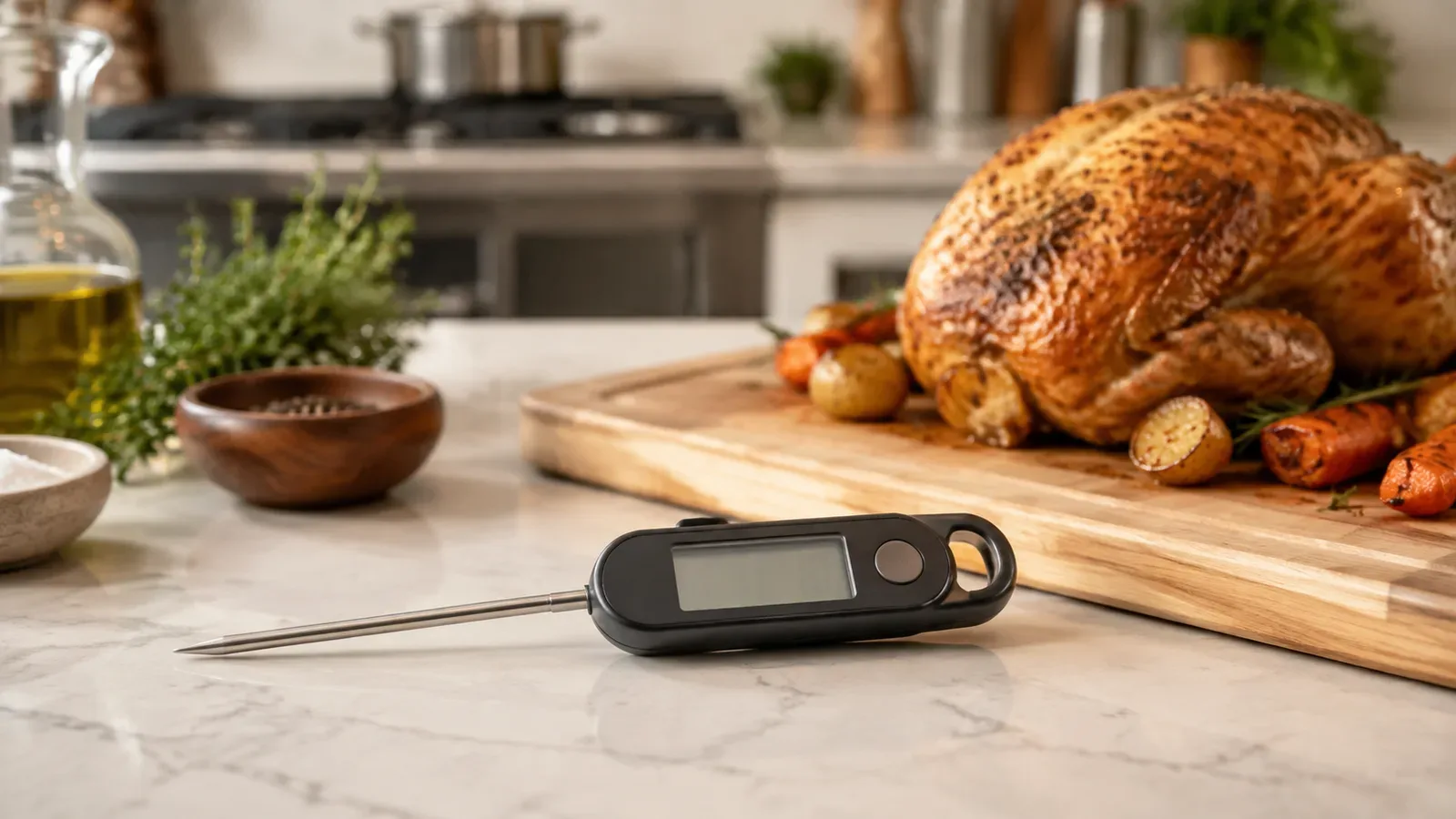
An instant-read thermometer is one of the few kitchen tools that can replace a visual guess with a useful measurement. Color, juices, and cooking time can suggest doneness, but they do not reliably prove that the coldest part of a food reached a safe temperature. The USDA Food Safety and Inspection Service recommends using a food thermometer and checking safe minimum internal temperatures.
The buying decision is less about finding the most dramatic speed claim and more about choosing a probe that fits the foods you cook, a display you can read over a hot pan, and controls you will actually use.
Top picks
These three thermometers have exact, manually verified Amazon.com product destinations in Majumedia’s catalog. We have not assigned ratings or claimed hands-on testing; the distinctions below focus on design and likely fit.
- Alpha Grillers Digital Meat Thermometer: a straightforward choice for cooks who want a conventional folding instant-read tool without app setup.
- TempPro TempSwift 1 Sec Instant Read Meat Thermometer Digital: best suited to cooks who value a motion-activated, rotating display when checking food from awkward angles.
- Lavatools Javelin PRO Classic: a strong fit for readers who prefer a larger professional-style folding format and simple local controls.
Quick comparison
| Product | Best for | Meaningful strength | Trade-off to consider |
|---|---|---|---|
| Alpha Grillers Digital Meat Thermometer | Everyday grilling and kitchen checks | Simple folding-tool approach | Verify the display and control layout suits your grip |
| TempPro TempSwift | Reading from changing angles | Rotating, motion-activated display | Extra automation may be unnecessary for cooks who prefer basic controls |
| Lavatools Javelin PRO Classic | Frequent spot checks | Large professional-style folding format | The larger body may take more drawer space |
Choose by handling and workflow rather than an unverified speed or accuracy headline. Confirm current manufacturer documentation before relying on any feature that matters to your cooking routine.
Instant-read versus leave-in thermometers
An instant-read thermometer is designed for spot checks near the end of cooking. You insert the probe, wait for the reading to settle, remove it, and check another location if needed. It should not stay in the oven unless the manufacturer explicitly says it is oven-safe.
A leave-in probe thermometer remains in the food while a cable or wireless transmitter reports temperature. It is useful for roasts and long cooks, but it does not replace spot checks across a large piece of meat. Many kitchens benefit from both types because they solve different problems.
The features that matter
A thin, practical probe
A narrow tip leaves a smaller puncture and reaches the center of thin foods more easily. Probe length matters for deep pots and large roasts. A folding probe protects the tip in a drawer and can switch the unit on automatically, while a fixed probe may be simpler to sanitize.
A display you can see from either side
Large digits, strong contrast, and a backlight help in a dim oven or outdoor grill. An auto-rotating display is valuable for left-handed use and awkward angles. Confirm that the reading remains visible long enough after you remove the probe.
Response and stability
Manufacturers often advertise a reading time, but real performance varies with food, insertion depth, and the size of the temperature change. A useful thermometer approaches a stable result quickly and does not jump wildly while held still. Repeatability is as important as headline speed.
Water resistance and cleaning
Food-contact surfaces need cleaning after every use, especially between raw and cooked foods. Water resistance makes wiping safer, but it does not automatically mean the device can be submerged or placed in a dishwasher. Follow the manual and keep water out of seams, battery doors, and charging ports.
How to check food correctly
- Insert the probe into the thickest part, away from bone, gristle, and the cooking surface.
- For thin items such as burger patties or chicken breasts, insert from the side so more of the sensing area reaches the center.
- Check more than one location. Large or irregular foods can have hot and cold zones.
- Compare the final reading with the current USDA safe-temperature chart for that food.
- Clean the probe before using it on another item.
For a whole bird, large roast, or stuffed food, consult the USDA guidance for the correct locations and holding times. A single reading at an easy-to-reach edge is not enough.
Understanding accuracy claims
Accuracy is normally stated as a tolerance within a temperature range. Read the full specification rather than assuming one number applies from freezer temperatures to high-heat frying. Calibration support is useful, but consumer checks have limits.
An ice-water check can reveal a major problem when performed correctly with plenty of ice and minimal contact with the glass. Boiling-water checks are affected by elevation and atmospheric conditions. If a thermometer cannot be adjusted, a documented small offset may be workable; large or inconsistent errors are a reason to replace it.
Comparison checklist
| Feature | Why it matters | Question to ask |
|---|---|---|
| Probe geometry | Reaches the center of thin and thick foods | Is the sensing area documented? |
| Display | Reduces misreading at awkward angles | Does it rotate or hold the reading? |
| Response | Makes multi-point checks practical | Does the number settle consistently? |
| Ingress protection | Supports safer cleaning | Can it be rinsed, wiped only, or submerged? |
| Calibration | Extends useful life | Can the user adjust an offset? |
| Battery | Affects readiness and waste | Replaceable cell or rechargeable? |
Features you may not need
Bluetooth, apps, preset menus, and spoken alerts can be helpful in specialized situations, but they also add setup. An instant-read tool should still provide a clear local reading without an account or phone connection. Built-in presets can become outdated or may not reflect the exact food and preparation method, so use an authoritative temperature chart rather than relying only on color-coded labels.
Common mistakes
Do not measure only the outer edge, touch the probe to a hot pan, or assume the first number is final. Do not leave a standard instant-read unit inside an oven. Avoid cross-contamination by cleaning between raw and cooked items, and never use a damaged probe with exposed wiring or a loose hinge.
Product identity sources
- Amazon product page: Alpha Grillers Digital Meat Thermometer
- Amazon product page: TempPro TempSwift
- Amazon product page: Lavatools Javelin PRO Classic
The bottom line
Choose the thermometer that makes correct measurement easy: a thin probe, readable display, stable response, documented accuracy, and cleaning instructions that fit your routine. Then use it in the thickest part, check multiple locations, and consult the USDA chart. A straightforward thermometer used correctly is more valuable than a feature-heavy one left in a drawer.
If you are upgrading other everyday kitchen routines, Majumedia's coffee maker comparison explains another category where the right format matters more than the longest specification sheet.