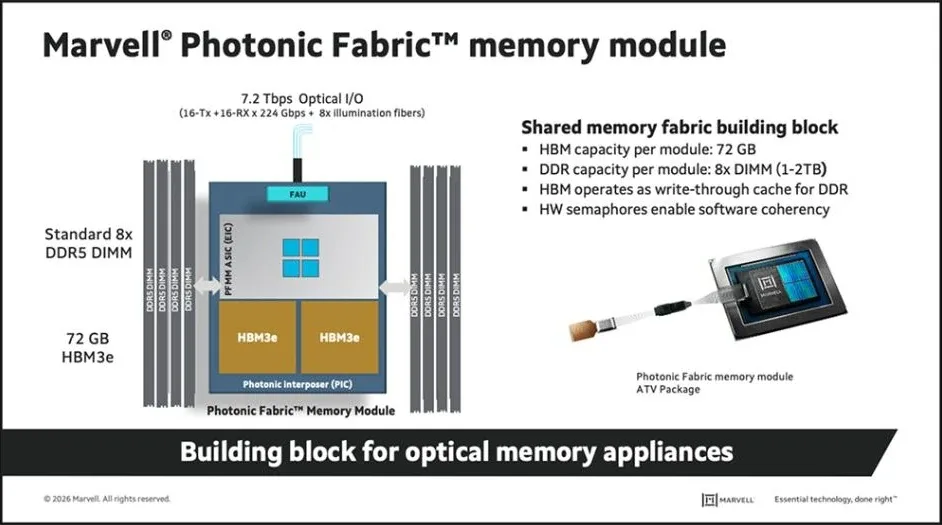
Marvell has shown its Photonic Fabric Memory Module, a design that uses light instead of copper to share a large pool of memory between GPUs and servers. Each module combines 72GB of HBM3e with up to eight DDR5 slots and optical links, and an appliance of 16 modules can pool 32TB of DDR5 plus 1,152GB of HBM3e across up to 16 hosts. It is still pre-silicon, with customer sampling targeted for 2027.
How Marvell's Photonic Fabric works
The Photonic Fabric Memory Module by Marvell represents a departure from conventional copper-based connections, utilising optical fibres to link memory modules. According to TechRadar, up to 16 of these modules form an appliance that shares the impressive memory pool across various processors. In doing so, it enables shared memory capabilities that could extend beyond current local limits inherent in high-performance computing and AI workloads.
Potential advantages for AI and computing
The introduction of Marvell's Photonic Fabric is particularly strategic for AI, where memory requirements grow exponentially. A major advantage is the decoupling of memory from processors, enabling systems to expand memory capacity independently of computational resources, potentially reducing capital expenditures. This contrasts with current practices where additional processors must be purchased to scale memory, escalating costs significantly.
Nvidia's involvement and competition
Interestingly, Nvidia has expressed both interest and competition in this sphere. With a $2 billion investment in Marvell, Nvidia secures a stake in developments it also mirrors with its own technologies like the BlueField-4 STX. According to TechRadar, Nvidia aims to advance memory and storage solutions parallel to Marvell's, reflecting an industry-wide shift towards more flexible memory scaling solutions.
Challenges and industry outlook
Despite the potential benefits, Marvell's Photonic Fabric Memory faces challenges such as technological maturation, proof of real-world efficiency, and competitive market dynamics. The current high costs of DDR5 memory further complicate the economic picture. The technology is still in the pre-silicon stage, with samples expected by 2027, leaving room for potential developments and shifts in the market.
What it means for current buyers
For PC builders and gamers, nothing changes yet. Photonic Fabric is aimed at data centres running large AI models, where the cost of adding memory by buying more GPUs is enormous. Over time, though, ideas that start in AI infrastructure tend to influence how memory is priced and supplied for everyone.
If you are upgrading a desktop today, conventional DDR5 is still the answer. A 32GB DDR5-6000 kit such as Corsair Vengeance RGB is the sweet spot for gaming and creative work on current AMD and Intel platforms, and buying when prices dip is more useful than waiting for technology that is years away from consumer hardware.
Conclusion
Marvell's Photonic Fabric Memory introduces a promising development in the realm of high-capacity GPU setups, offering potential benefits such as shared memory capability and cost-efficiency. While Nvidia and other industry players are also exploring similar fronts, the true impact of this technology will unfold over the coming years as it transitions from concept to practical deployment. Until then, consumers should watch this space while utilising currently available technologies for their computing needs.