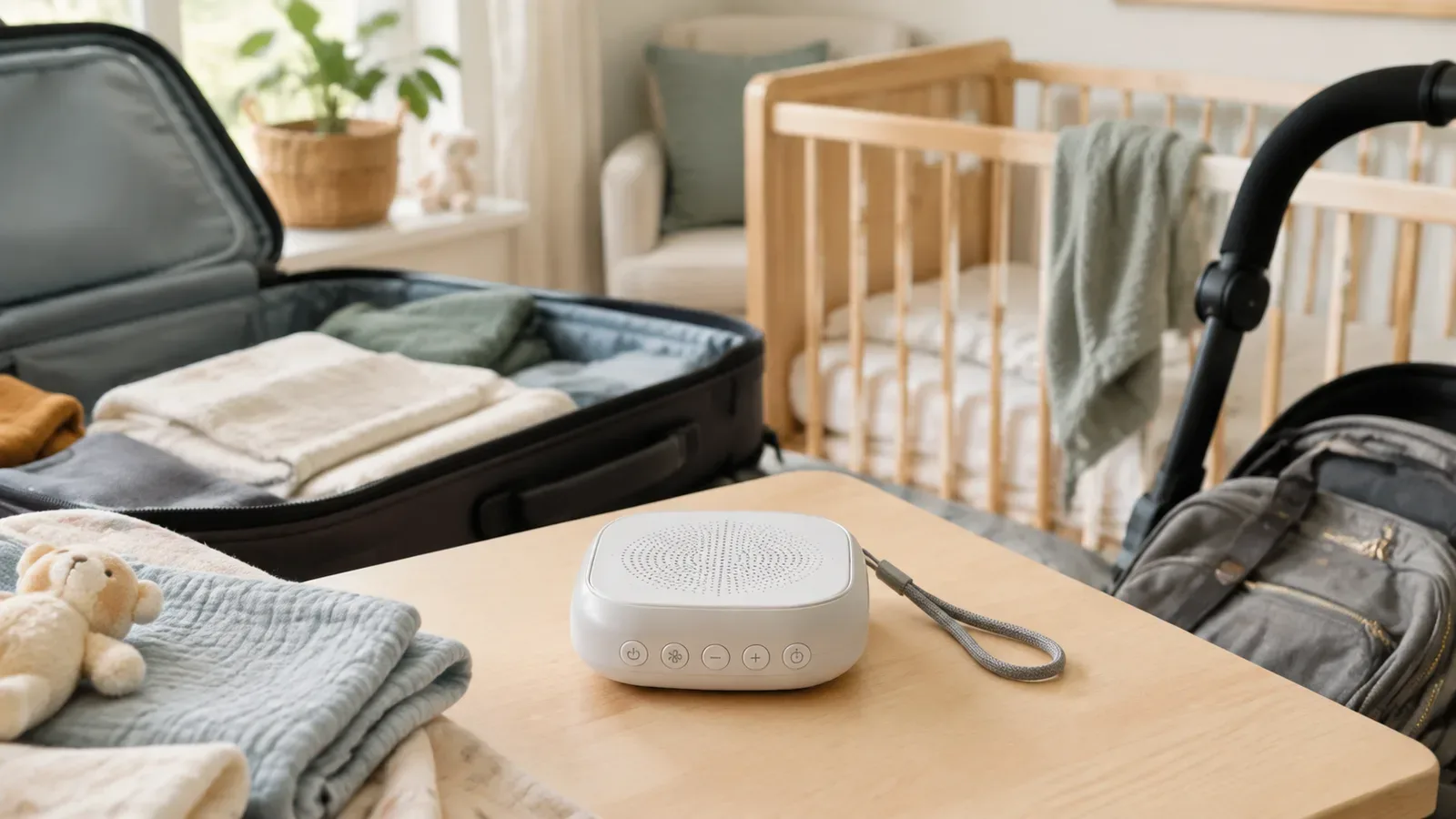
Travel can scramble a baby's familiar sleep cues: a different room, hallway noise, an early sunrise, or relatives talking just beyond the door. A portable sound machine cannot guarantee sleep, but it can provide one consistent part of the bedtime routine. The useful question is not which model has the longest feature list. It is which small machine is easy to control, charge, position safely, and use at a restrained volume wherever your family stays.
What a portable sound machine can—and cannot—do
A sound machine creates a steady background that can soften sudden changes in environmental noise. That may make a hotel room, rental home, or grandparent's house feel more predictable. It is still only one cue. Feeding, comfort, room temperature, light, and a familiar wind-down routine matter too.
It is important not to treat louder as better. The American Academy of Pediatrics warns that some infant sleep machines can produce hazardous noise levels and advises placing a machine as far from a baby's head as possible and using it for a short time only. Start at the lowest useful setting, keep the device away from the crib or sleep surface, and never place loose cords or a hanging accessory within a child's reach.
The features that matter most for travel
Simple volume controls
Look for controls you can operate in a dark room without cycling through a dozen modes. Separate volume buttons are easier than a single multifunction control. A physical lock is valuable in a diaper bag because it prevents the machine from switching on or changing volume accidentally.
Battery behavior you can understand
Battery-life estimates depend on volume, light use, wireless features, and battery age, so treat marketing figures as a ceiling rather than a promise. A clear battery indicator is often more useful than an ambitious runtime claim. USB-C charging is convenient if it lets you share a charger with a phone, but check the product manual: not every USB-C device supports every charger or power-delivery mode.
A timer and a true continuous mode
A timer can cover a nap or the first part of bedtime without running all night. Continuous playback may be useful when the surrounding building is noisy. Make sure the controls distinguish those modes clearly; an unexpected shutoff can be more disruptive than a basic sound library.
Portable, but stable
Compact devices are easy to pack, yet very light models can be knocked over. A flat base works well on a dresser or shelf. A clip or loop can help during transit, but once the device is in the room, position it well away from the baby rather than attaching it to a crib, bassinet, or play yard.
Sound choices: steady beats fancy
White, pink, and brown noise differ in how energy is distributed across frequencies. Fans, rainfall, and other continuous sounds can feel gentler to some listeners. The label matters less than whether the track loops smoothly without obvious clicks, voice fragments, or sharp high-frequency details. Try the machine before travel and choose one neutral sound the family can reproduce consistently.
Built-in lullabies and nature tracks are optional, not essential. More sounds can make selection slower at 2 a.m. A favorite setting memory is genuinely useful because it restores the same sound and volume after charging.
A practical hotel-room setup
- Choose a stable surface away from the crib, bassinet, or bed.
- Route the charging cable where a child cannot reach it and where adults will not trip.
- Set the lowest volume that softens intermittent noise.
- Stand near the sleep space and confirm the sound is background, not the dominant thing you hear.
- Use a timer if it meets the need; otherwise reassess volume and placement before leaving continuous playback on.
If the room has a loud HVAC system, elevator, or street-facing window, move the machine toward the source of disruption rather than toward the baby. Closing a door or using a rolled towel at the bottom of a drafty doorway may reduce noise without adding volume.
What to check before buying
- Charging: connector type, included cable, and whether it works while charging.
- Controls: dedicated volume buttons, lock, timer, and memory.
- Indicator lights: dimmable or switchable so they do not brighten a dark room.
- Cleaning: a smooth housing without deep fabric seams is easier to wipe.
- Travel durability: recessed buttons and a protected charging port reduce bag damage.
- Documentation: clear instructions for placement, charging, and operating limits.
Common mistakes to avoid
Do not put the machine inside the crib, under bedding, or beside the baby's head. Do not use a loud setting to cover conversation that could simply move to another room. Avoid dangling straps and charging cords near the sleep area. Finally, do not introduce a brand-new sound on the first night of a trip; test it at home so it becomes familiar rather than stimulating.
The bottom line
The best portable baby sound machine is small, predictable, easy to dim, and easy to run quietly. Prioritize restrained volume, safe placement, straightforward controls, and dependable charging over decorative lights or an enormous audio library. A simple device used thoughtfully can make an unfamiliar room feel more consistent without becoming the center of the sleep routine.
For other practical travel preparation, see Majumedia's travel adapter guide.