California is putting a human check on AI-driven firings. On September 30, 2026, Governor Gavin Newsom signed SB 947, a law that stops employers from relying solely on an automated system when they discipline or terminate a worker. It was part of a package of workplace AI bills signed the same day, and it arrives one year after Newsom vetoed a broader version of the idea.
Here is what the law requires, when it takes effect, what it leaves out, and how it fits with the other AI workplace rules California approved.
What SB 947 actually requires
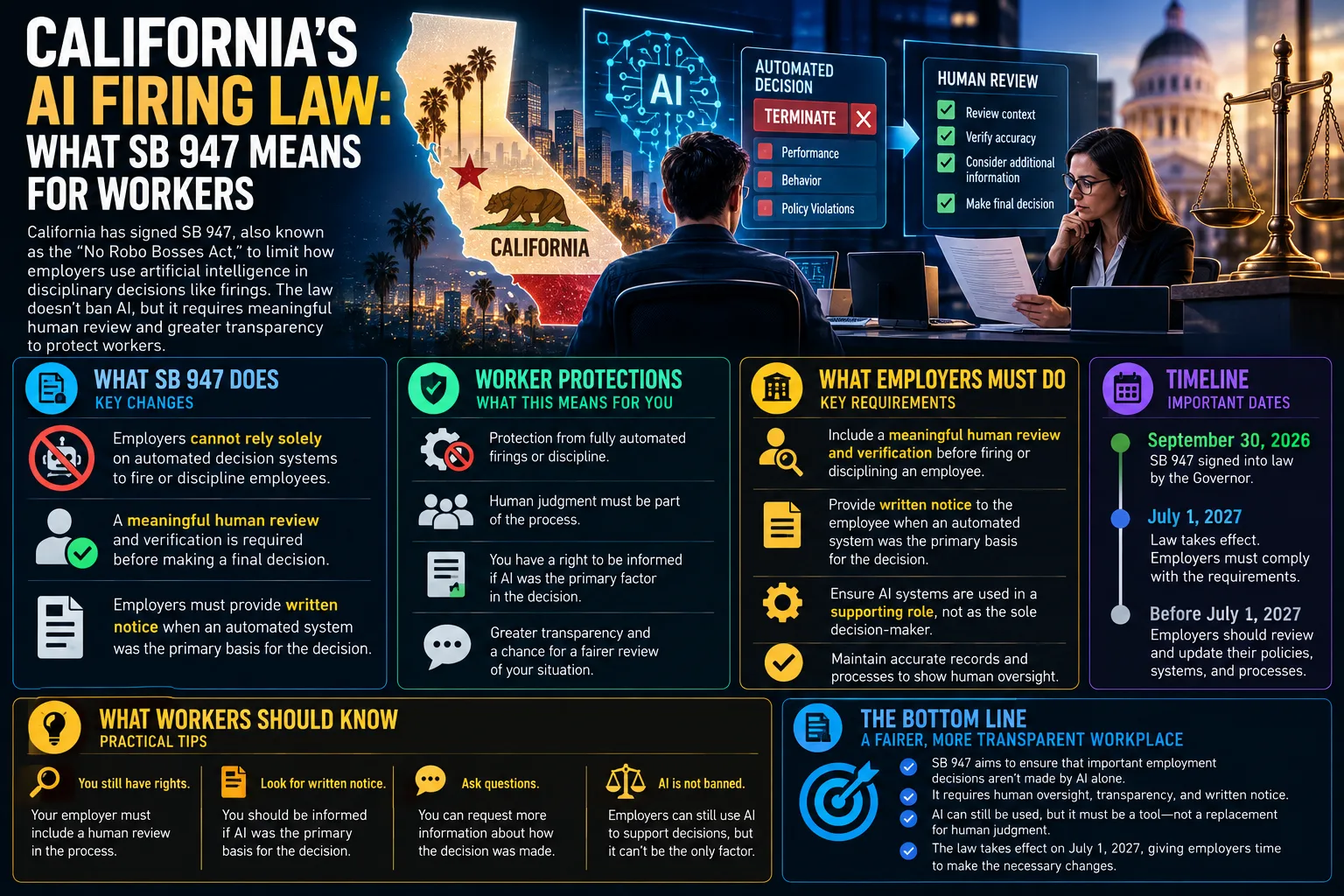
SB 947, authored by Sen. Jerry McNerney and promoted as the "No Robo Bosses Act," targets what California calls automated decision systems (ADS). Reporting on the bill describes an ADS as a computational process, such as machine learning, statistical modeling, data analytics or AI, that produces a score, classification or recommendation used to assist or replace human decisions that materially affect people.
The law does not ban these tools. Employers can still use them in disciplinary decisions. What changes is how much weight they can carry:
- No sole reliance: an employer cannot discipline or fire someone based only on the output of an automated system.
- Human corroboration: when an employer primarily relies on ADS output, a person must verify the decision using the underlying data or other supporting information, such as evaluations and personnel files.
- Bad output can't be used: if the reviewer can't corroborate the output, or finds it inaccurate, incomplete or misleading, it can't be used for that decision.
- Written notice: workers must be told in writing when an automated system was primarily relied on, at the time the decision is communicated.
- Access to data: affected employees can request a description of the data about them that the system used.
When it starts and how it is enforced
The rules take effect on July 1, 2027, giving employers about nine months to review their tools and processes. According to reporting on the final bill, the California Labor Commissioner and public prosecutors can enforce it, violations carry a civil penalty of $500 each, and workers are protected from retaliation for asserting their rights.
What the law does not cover
SB 947 is deliberately narrower than its predecessor, and a few gaps are worth knowing:
- Hiring is not included. The human-review and notice rules apply to discipline and termination, not to screening or hiring candidates.
- Rideshare drivers are excluded. Drivers classified as independent contractors under California's Proposition 22 are not covered, a point that drew criticism from Rideshare Drivers United.
- AI is still allowed. Employers can keep using automated scoring and monitoring tools, as long as a human corroborates any discipline or firing decision they primarily rely on.
Why Newsom signed it this time
In 2025, Newsom vetoed SB 7, an earlier McNerney bill on the same subject, citing what he described as unfocused notification requirements and overly broad restrictions on AI tools. The 2026 version narrows the focus to discipline and termination and to human corroboration. McNerney framed the goal plainly: no worker should be fired or disciplined by a "robo boss."
The other AI workplace laws signed alongside it
SB 947 was one of several bills Newsom signed on September 30. The others include:
- SB 951 (Reyes): updates California's WARN Act so mass layoff, relocation or termination notices must disclose when AI or automation was a cause.
- AB 1883 (Bryan): bars workplace surveillance tools that infer or predict employees' emotional states or collect neural data, with exceptions.
- AB 1331 (Elhawary): limits the use of surveillance tools in workplace bathrooms.
- AB 1979 (Bonta): keeps AI advisory in health care, so it cannot replace the clinical judgment of licensed professionals.
Newsom vetoed two other AI bills the same day, including AB 2575, which would have protected health care workers who override AI recommendations they consider unsafe.
What this means for workers and employers
For workers in California, the practical change is transparency: if an algorithm played the main role in a disciplinary decision or firing, you should be told in writing, and you can ask what data about you it used.
For employers, the work starts with an inventory. Employment law firms such as Jackson Lewis have advised identifying which workplace tools could count as an automated decision system, mapping where their outputs feed into discipline or termination, and building a documented human-review and notice process before July 2027. This article is general information, not legal advice; companies should check the final bill text with counsel.
The law also adds to a broader trend of rules aimed at making AI systems more accountable, from AI image credentials in Windows to growing scrutiny of AI data centers' effect on electricity bills. If your workplace uses AI-driven monitoring tools, it is also worth understanding the risks of AI-powered cyberattacks that target the same data.
Does SB 947 ban AI in the workplace?
No. Employers can still use automated systems. They cannot rely on them alone to discipline or fire someone, and a human must corroborate decisions where the system is the primary basis.
When does California's AI firing law take effect?
July 1, 2027.
Does the law apply to hiring?
No. SB 947's human-review and notice requirements apply to discipline and termination decisions, not hiring.
Are gig and rideshare drivers covered?
No. Drivers classified as independent contractors under Proposition 22 are excluded.
- KQED: Newsom Signs Slate of AI Workplace Laws, Barring Robo Bosses and Surveillance
- HR Dive: California revamps AI protections for workers in flurry of bill signings
- TechInformed: California bars AI from firing employees on its own
- Engadget: California’s new law bans companies from relying on AI to fire workers
- Office of Governor Gavin Newsom: California’s nation-leading AI framework just got stronger
- Akin Gump: California Enacts Limits on Automated Decision Systems in Employment Discipline (SB 947)