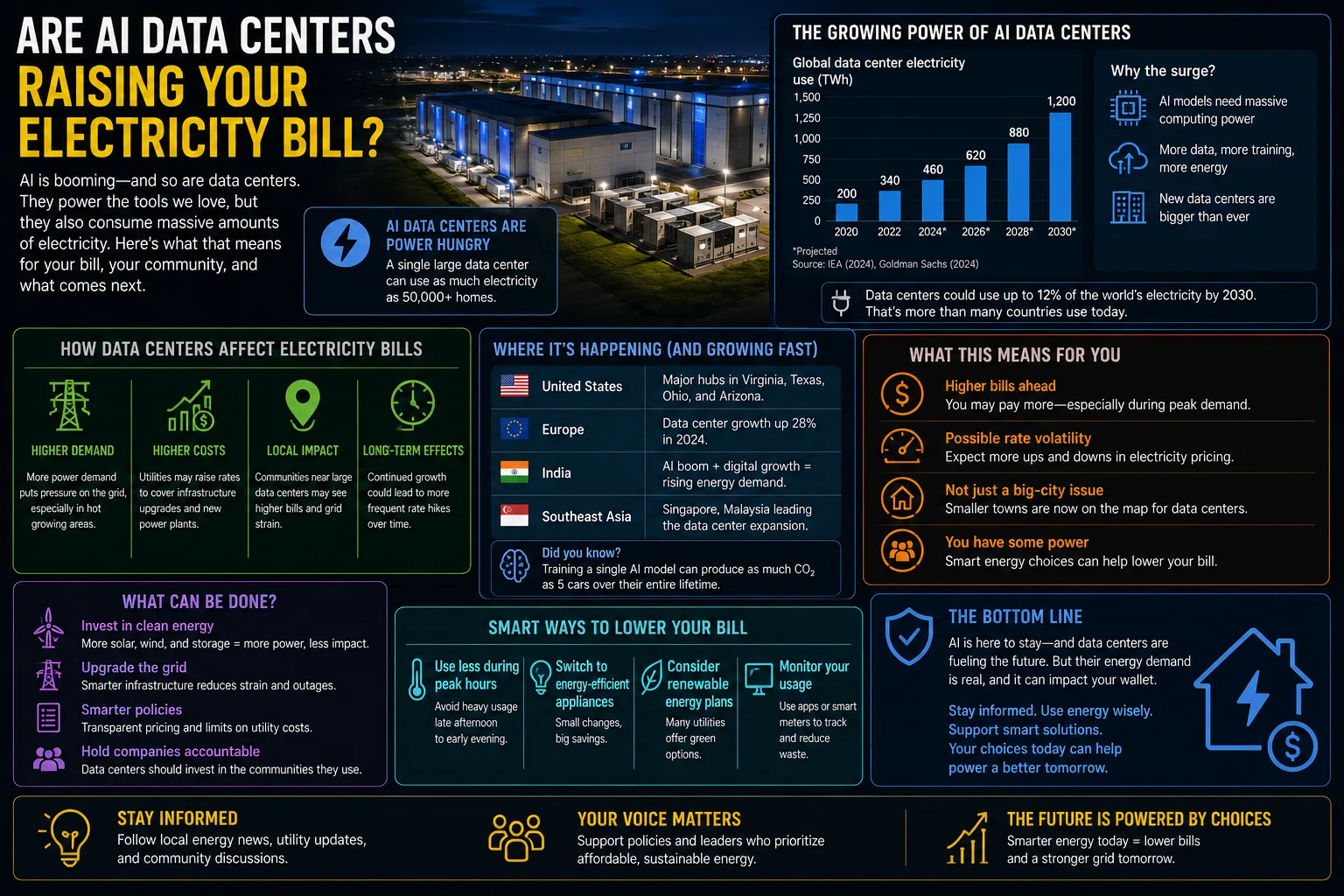
Virginia — home to the largest concentration of data centres on the planet — has moved to stop utilities passing the cost of serving AI data centres on to ordinary households. Regulators there estimate the change could save residential customers hundreds of millions of dollars. It is the clearest sign yet that the electricity cost of the AI build-out has become a consumer issue rather than an industry one.
Here is what is actually happening to power bills, how much of it is attributable to AI, and where the savings you can control actually live.
Why data centres affect your bill at all
A large data centre campus can draw as much electricity as a small city, and it wants that power continuously. Serving it means new transmission lines, substations and generation capacity. Those are enormous capital projects, and utilities recover the cost through the rates they charge everyone connected to the grid.
The dispute is about allocation, not existence. If a utility builds a billion dollars of infrastructure primarily to serve a handful of very large customers, who pays for it? Historically some of that cost has been spread across the whole customer base, including households whose own consumption did not change. Regulators in several states are now requiring large-load customers to carry more of it directly, through dedicated rate classes and long-term contracts.
What is actually pushing bills up
| Factor | Contribution | Under your control? |
|---|---|---|
| Grid infrastructure upgrades | Significant and rising | No |
| Natural gas and fuel prices | Historically the largest driver | No |
| Data centre demand growth | Growing, regionally concentrated | No |
| Extreme weather and peak demand | Significant | Partly — via usage timing |
| Heating and cooling in your home | Often 40–50% of a bill | Yes |
| Water heating | Typically 15–20% | Yes |
| Standby and always-on devices | Usually 5–10% | Yes |
Worth being honest about proportion here: fuel costs, weather and general grid investment still dominate most bills. Data centre growth is real and is concentrated in specific regions — northern Virginia, parts of Texas, Ohio and Georgia most visibly — rather than spread evenly across every household in the country.
What regulators are doing about it
The emerging policy toolkit is fairly consistent across states considering the issue:
- Dedicated large-load rate classes. Very large customers are placed in their own category so their infrastructure costs are not blended into residential rates.
- Minimum take-or-pay contracts. Data centre operators commit to paying for capacity they reserve, whether or not they use it, so households are not left holding stranded costs if a project shrinks.
- Longer contract terms. Multi-decade agreements matched to the lifespan of the infrastructure being built.
- Bring-your-own-generation requirements. Some jurisdictions are pushing operators to procure their own new generation rather than drawing on shared capacity.
- Transparency requirements. Public reporting on which costs are allocated where, which is what makes the rest enforceable.
What you can actually control
Policy will take years. Your own consumption will not, and the numbers there are larger than most people assume — heating, cooling and hot water typically account for well over half of a residential bill.
- Adjust the thermostat by one or two degrees. The single highest-value change, and the one people resist most. Each degree is worth a meaningful percentage of heating and cooling cost.
- Check whether you are on a time-of-use tariff. If so, shifting laundry, dishwashing and car charging to off-peak hours can cut costs without changing consumption at all.
- Lower the water heater setpoint. Many are factory-set higher than necessary; 120°F is generally sufficient and safer for households with children.
- Seal drafts before upgrading appliances. Weatherstripping and caulk are cheap and often outperform a new device.
- Deal with standby loads. Set-top boxes, game consoles in instant-on mode and old desktop machines draw power continuously for no benefit.
- Check for a utility rebate programme before buying anything. Many cover insulation, smart thermostats and appliance upgrades directly.
Kitchen appliances are a good place to find easy wins, since a countertop device frequently uses a fraction of the energy of a full oven for the same job — our air fryer buying guide covers which models are genuinely efficient rather than merely fast. If your home office equipment is the always-on culprit, our home office upgrade guide covers lower-draw alternatives.
Does using AI tools increase your own bill?
Barely, and not in the way people imagine. The computation happens in a data centre, so it appears on that operator's electricity bill rather than yours. Your device draws roughly the same power whether you are using a chatbot or reading a news site.
The aggregate effect is real at a national grid level, and it is entirely reasonable to have views about that. But if your bill went up this year, the cause is far more likely to be fuel prices, a cold snap, a heatwave or a rate case in your state than your own use of AI tools.
What to expect next
Electricity demand growth has resumed after two decades of being essentially flat, driven by data centres, electrification of heating and transport, and manufacturing. That means grid investment will continue, and rates will reflect it. The policy question that matters for households is not whether the infrastructure gets built, but who is billed for it — and that is being actively decided in state regulatory proceedings right now, which are open to public comment.
AI data centres and electricity bills FAQ
Are data centres really raising electricity bills?
In regions with heavy data centre concentration, the associated grid investment does contribute to rate increases. Nationally, fuel costs and weather remain larger drivers for most households.
What did Virginia actually do?
Regulators there moved to limit how much of the cost of serving large AI data centre loads can be recovered from residential customers, with estimated savings for households in the hundreds of millions of dollars.
Does using ChatGPT raise my power bill?
Not meaningfully. The computing happens remotely, so the energy cost falls on the data centre operator. Your own device consumption is essentially unchanged.
What uses the most electricity in a home?
Heating and cooling typically account for the largest share, often 40 to 50 percent, followed by water heating. Electronics and lighting are usually much smaller than people expect.
Will electricity prices keep rising?
Demand growth has resumed after a long flat period, and grid investment is increasing. Whether that translates into higher residential rates depends substantially on how regulators allocate those costs.
Can I object to a rate increase?
Yes. Utility rate cases are public proceedings before state regulators, and most accept written comment from residential customers.
Sources
- Virginia State Corporation Commission filings and orders
- US Energy Information Administration residential consumption data
- Utility rate case documentation
- Ars Technica
- Reuters