Travel charging is easiest when every device shares the same small set of cables and power sources. The goal is not to carry the charger with the largest number on the box; it is to build a compact kit that can safely cover your phone, tablet, headphones and USB-C laptop without creating a tangle of duplicate adapters. This guide focuses on practical buying decisions for US travelers and uses existing Majumedia catalog products where an exact offer is available. Majumedia has not claimed hands-on testing of these products, so confirm the current listing, included accessories and warranty before buying.
Quick recommendations
| Product | Best for | Main advantage | Consider before buying |
|---|---|---|---|
| UGREEN Nexode 145W Power Bank | Work trips with a USB-C laptop | One battery for a computer and smaller devices | More weight than a phone-only battery |
| Anker Prime 27,650mAh Power Bank | Long travel days and several devices | High-capacity, multi-device role | Premium price and substantial size |
| UGREEN Nexode 100W wall charger | Hotel and desk charging | Can replace several separate charging bricks | No stored power away from an outlet |
| USB-C multiport hub | Thin laptops with limited ports | Adds useful connections at a destination | Not a charger unless power delivery is supported |
Best overall travel power bank: UGREEN Nexode 145W
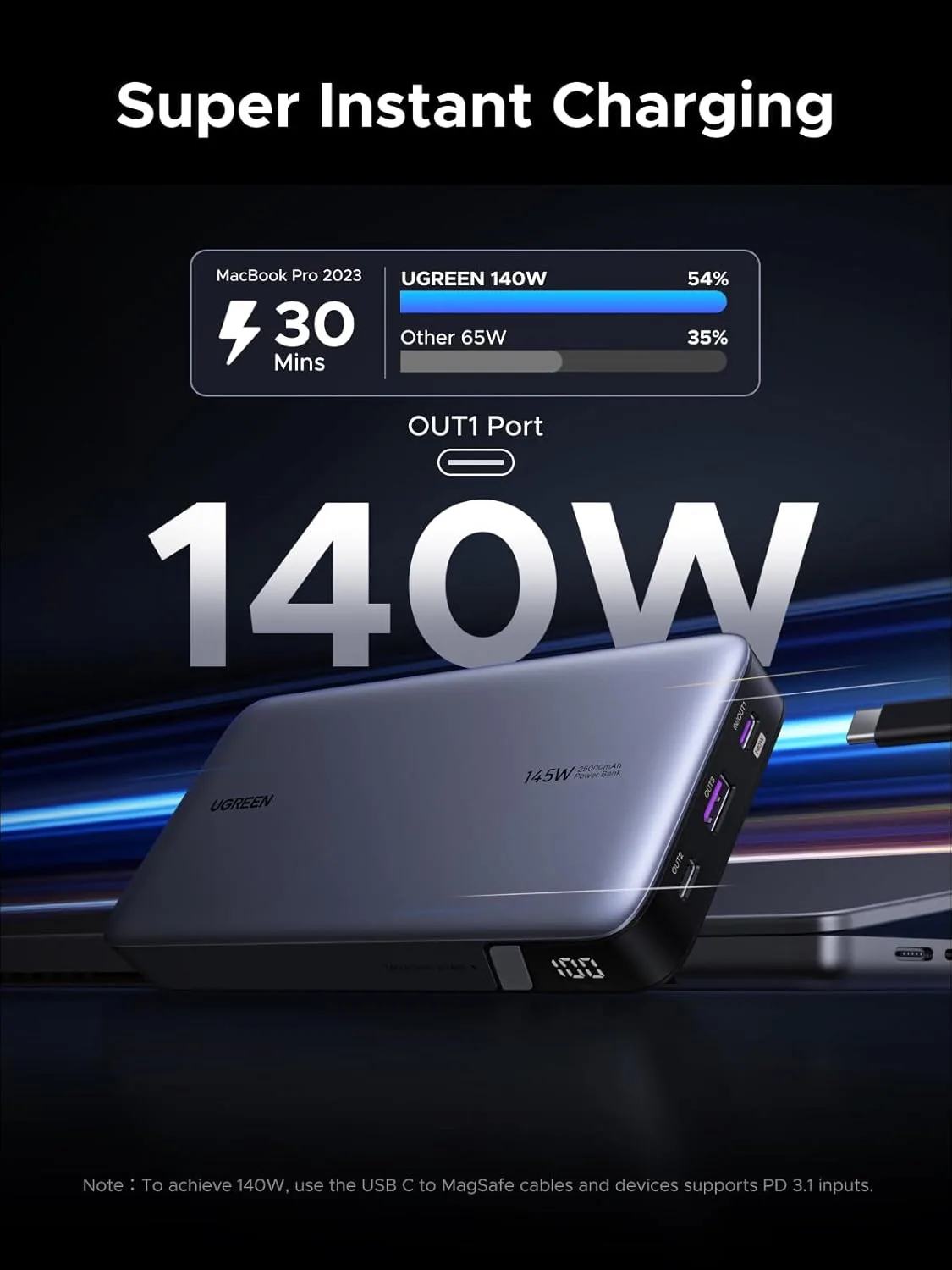
The UGREEN Nexode 145W Power Bank is the most balanced fit for travelers who need to recharge a USB-C laptop as well as a phone. Its appeal is consolidation: one battery can take the place of a smaller phone bank plus a second laptop-specific solution. That is useful on trains, in airports and during long stretches away from a dependable outlet.
Best for
Choose it for business travel, remote work and trips built around a USB-C notebook. A phone-only traveler is unlikely to benefit enough from the extra capacity and weight.
Pros
- Useful role as a shared power source for several USB-C devices.
- Reduces the need to carry separate laptop and phone batteries.
- Existing Majumedia catalog record includes a verified Amazon offer.
Cons
- Bulkier than a pocket-size emergency battery.
- Maximum output can depend on the port and number of connected devices.
- A suitable high-output USB-C cable remains essential.
Best for maximum travel capacity: Anker Prime 27,650mAh
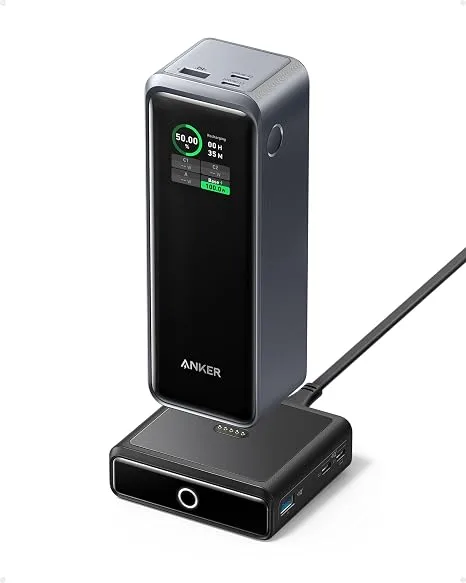
The Anker Prime 27,650mAh Power Bank is aimed at people who spend long periods between outlets or carry several power-hungry devices. It is better understood as portable infrastructure than a casual phone accessory. The larger format can make sense for a creator, consultant or family sharing one battery, but it is excessive for short city breaks.
Pros
- Well suited to multi-device travel days.
- Can simplify a kit shared by a phone, tablet and compatible laptop.
- Exact existing product and Amazon offer are available through Majumedia.
Cons
- Size and weight work against minimalist packing.
- High capacity does not remove airline battery restrictions.
- Travelers should verify the exact model rather than relying on the broad Prime family name.
When a wall charger is the smarter purchase
A multiport GaN wall charger is usually the better first purchase when most charging happens in hotels, coworking spaces or relatives' homes. It carries no stored energy, so it is lighter than a power bank and avoids the question of whether a large battery is allowed in checked luggage. A model such as the UGREEN Nexode 100W wall charger can potentially replace several device-specific bricks, but the current catalog did not provide a sufficiently safe US Amazon match for attachment.
Remember that a travel plug adapter changes the physical plug shape; it does not necessarily convert voltage. Check the input range printed on every charger and consult Majumedia's guide to travel adapters before an international trip.
How to choose a USB-C travel charger
Start with the largest device
Find the charging requirement for the laptop or tablet that draws the most power. A phone can generally share a capable USB-C Power Delivery charger, but a low-output phone brick may not keep a laptop charged during use. Use the device manufacturer's documentation rather than guessing from connector shape alone.
Check power sharing
The advertised maximum usually describes a particular port under particular conditions. When two or three ports are occupied, the charger may divide its output. Read the exact port-allocation information if you expect to charge a computer and phone simultaneously.
Match the cable to the job
USB-C cables can look identical while supporting different charging and data capabilities. Use a cable rated for the required power, avoid damaged connectors and label similar cables if your travel kit mixes charging-only and high-speed data leads.
Understand capacity and airline rules
Power banks are normally judged for air travel by watt-hours, not simply the larger milliamp-hour number used in marketing. Keep batteries in cabin baggage when required and check the current policy of the airline operating each flight. Do not assume that approval by one carrier applies everywhere.
Buy the fewest ports you will use
Extra ports add flexibility, but they can also make a charger larger and complicate power sharing. Count the devices that genuinely need to charge overnight. Many travelers are better served by two capable USB-C ports than a crowded array of connectors they never use.
A practical two-piece travel kit
For a laptop-centered trip, pair one compact multiport wall charger with one verified power bank. Use the wall charger whenever an outlet is available and reserve the battery for transit. Phone-only travelers can downsize to a lighter battery and a smaller wall adapter. Keep the kit together in a pouch; Majumedia's cabin luggage buying guide offers broader advice on what realistically fits in a carry-on.
Frequently asked questions
Can one USB-C charger power a laptop and phone?
Often, yes, when the laptop supports USB-C Power Delivery and the charger and cable meet its requirements. Charging speed may fall when output is shared, so verify the exact charger's allocation table.
Is a 20,000mAh power bank allowed on a plane?
Airline decisions are based on the battery's stated watt-hour rating and current rules. Most consumer power banks must travel in cabin baggage, but always check the operating airline before departure.
Do I need a voltage converter?
Many modern USB chargers accept a broad international input range, but not all electrical devices do. Read the label on the exact charger. A plug adapter alone does not convert voltage.
Bottom line
The best USB-C travel charger is the smallest verified combination that covers every device you actually carry. For laptop travel, the UGREEN Nexode 145W and Anker Prime 27,650mAh power banks provide two existing catalog options with legitimate Amazon offers. Add a wall charger only after confirming its exact US model, and prioritize correct cables, realistic power sharing and airline compliance over headline numbers.