Checked bags go missing often enough that a $25 tracker has quietly become standard travel kit. Several airlines now accept tracker location data directly in baggage claims, which turns a gadget into genuine leverage when your suitcase does not arrive. With AirTag 2 reportedly extending range and third-party accessories now promising multi-year battery life, the choice in 2026 is less obvious than it used to be.
Here is how the main options compare for actual travel use, and which format to buy for each thing you want to keep track of.
How luggage trackers actually work
None of these devices use GPS. They broadcast a low-energy Bluetooth signal, and any compatible phone that walks past anonymously relays the location back to you. That means a tracker is only as good as the network behind it — density of phones matters far more than the hardware.
This is why the same tracker performs brilliantly in a busy airport terminal and poorly in a remote cargo warehouse at 3am. It also means the honest expectation is "which airport is my bag in," not "which shelf."
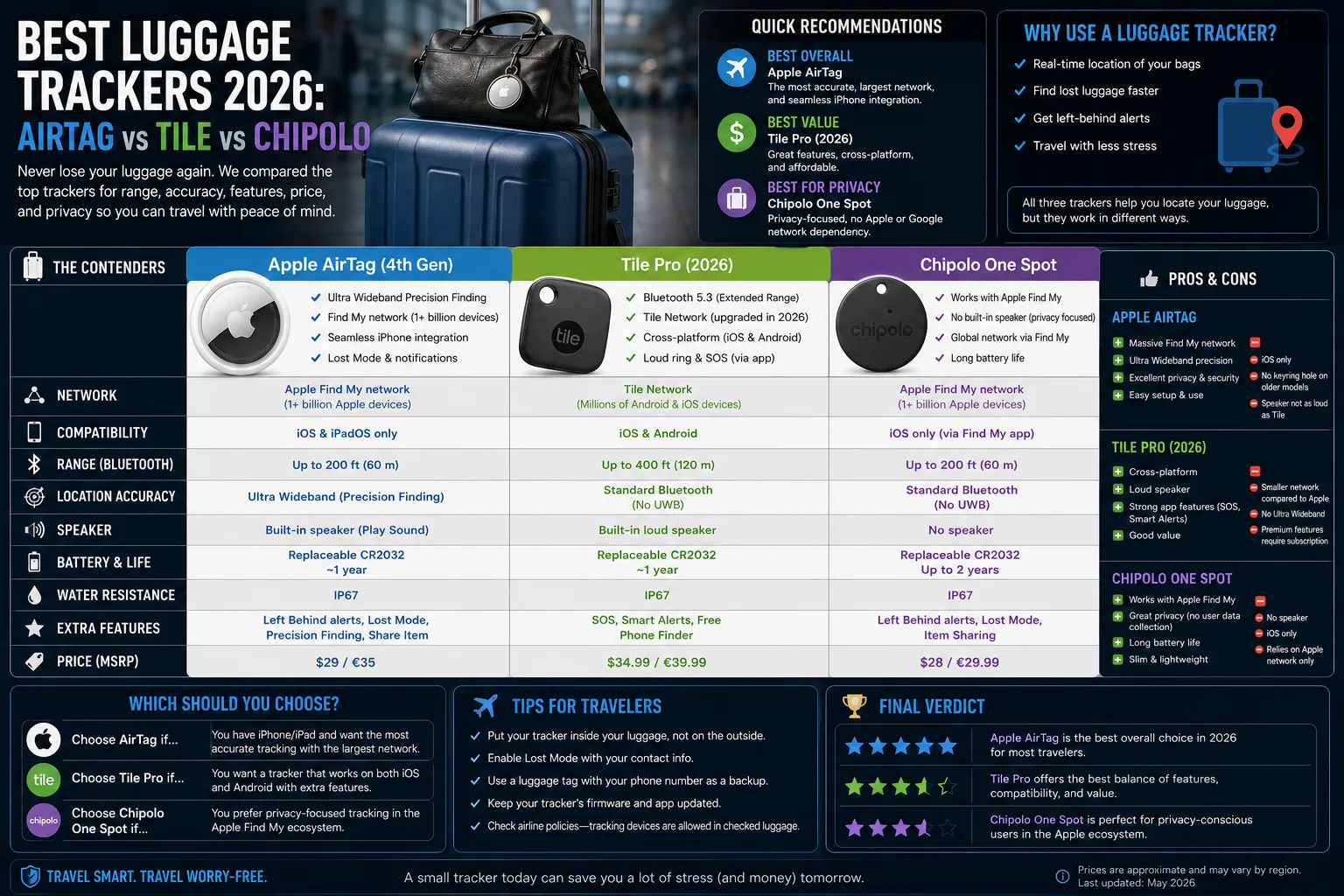
Luggage tracker comparison 2026
| Tracker | Best for | Network | Battery | Precision finding | Typical price |
|---|---|---|---|---|---|
| Apple AirTag | iPhone households | Find My (very large) | ~1 year, replaceable | Yes (UWB) | $25–$29 |
| Chipolo Pop | Mixed iPhone/Android homes | Both Apple and Google | ~1 year, replaceable | No | $29 |
| Tile Pro | Loud out-loud ringing | Tile network | ~1 year, replaceable | No | $35 |
| Google/Android trackers | Android-only households | Find Hub | 1–3 years | Model dependent | $20–$35 |
| Card-shaped trackers | Wallets, passport holders | Varies | 2–3 years, sealed | No | $30–$40 |
| Extended-battery cases | Set-and-forget luggage | Host tracker's network | Multi-year claims | Unaffected | $20–$40 |
Which one should you buy?
- Everyone in your household uses an iPhone. Buy AirTags. The Find My network is the largest of the lot, and precision finding genuinely helps in a crowded baggage hall.
- You use Android. Do not buy an AirTag — you cannot set it up. Choose a Chipolo or a Find Hub-compatible tracker instead.
- Your household is mixed. Chipolo's dual-network models are the pragmatic pick, so any family member can locate the bag.
- You want to find things inside your own home. Prioritise a loud speaker over network size. Tile is traditionally strongest here.
- You are tracking a wallet or passport wallet. Buy a card-format tracker. A disc tracker will not sit flat and will eventually fall out.
What AirTag 2 reportedly changes
Reporting points to a refreshed AirTag with a longer-range ultra-wideband chip, a louder speaker and a more tamper-resistant speaker assembly. Treat all of this as unconfirmed until Apple announces it — Apple has not published specifications, and pre-launch details change.
Practically, this matters less than people assume. Better ultra-wideband range improves the final few metres of a search. It does not improve the part that actually fails, which is a bag sitting in a warehouse with nobody's phone nearby. If you need a tracker for a trip in the next few months, buy now; the network, not the chip, does the heavy lifting.
Making the battery last
Standard coin-cell trackers run about a year. A category of accessory has emerged that houses the tracker in a larger case with a bigger cell, with vendors claiming several years of life. The trade-off is bulk, and claimed figures assume light use, so treat headline numbers as a ceiling rather than a promise.
- Replace batteries before long trips, not when the low-battery alert appears mid-journey.
- Buy quality coin cells and check that they are not the bitter-coated type, which some trackers refuse to seat properly.
- Keep a spare in your bag — they are tiny and weigh nothing.
- Turn off unnecessary separation alerts if constant notifications drive you to disable the tracker entirely.
- Store trackers out of extreme heat; coin cells lose capacity fast in hot cars and cargo holds.
Where to put the tracker in your bag
Bury it. A tracker in an outer pocket is the first thing a thief removes. Slide it into an interior lining pocket, inside a packing cube, or beneath the base panel of a hardshell case. Signal loss from a layer of fabric is negligible; the anti-theft benefit is not.
For carry-on, one tracker in the bag itself and one card tracker in the wallet covers the two most common losses. If you are still sorting out the bag itself, our cabin luggage buying guide covers which cases have interior pockets deep enough to conceal a tracker properly, and our rundown of travel adapters that actually work abroad handles the other thing people always forget.
Privacy and stalking protections
Every major tracker now participates in cross-platform unwanted-tracking alerts. If an unknown tracker travels with you, both iPhones and Android phones will warn you and help you locate it. That protection cuts both ways: it is also why a tracker hidden in a stolen bag may alert the person carrying it.
Use trackers to recover your own property. Do not use them to follow people — it is illegal in most places, and the platforms are explicitly designed to surface it.
Luggage tracker FAQ
Are luggage trackers allowed on planes?
Yes. Bluetooth trackers with small coin-cell batteries are permitted in checked and carry-on baggage by major aviation regulators, and several airlines now accept tracker data in lost-baggage claims.
Do AirTags work with Android phones?
No. AirTags require an iPhone or iPad for setup and tracking. Android users should choose Chipolo or a Google Find Hub-compatible tracker.
How accurate are luggage trackers?
Accuracy depends on nearby phones relaying the signal. In busy airports you can expect building-level accuracy or better; in remote areas updates may be hours apart.
How long does an AirTag battery last?
Apple rates the standard coin cell at roughly a year of typical use. Extended-battery accessory cases claim considerably longer, though real-world results depend on how often the tracker is queried.
Can someone track me with a hidden AirTag?
Both iOS and Android display unwanted-tracking alerts when an unknown tracker moves with you over time, and provide instructions for locating and disabling it.
Should I wait for AirTag 2?
If you are travelling soon, buy now. The reported upgrades mainly affect short-range precision finding, which is not usually the part that fails when a bag goes missing.
Sources
- Apple Find My and AirTag support documentation
- Google Find Hub documentation
- Chipolo and Tile product specifications
- The Verge
- 9to5Mac
- Airline baggage policy pages