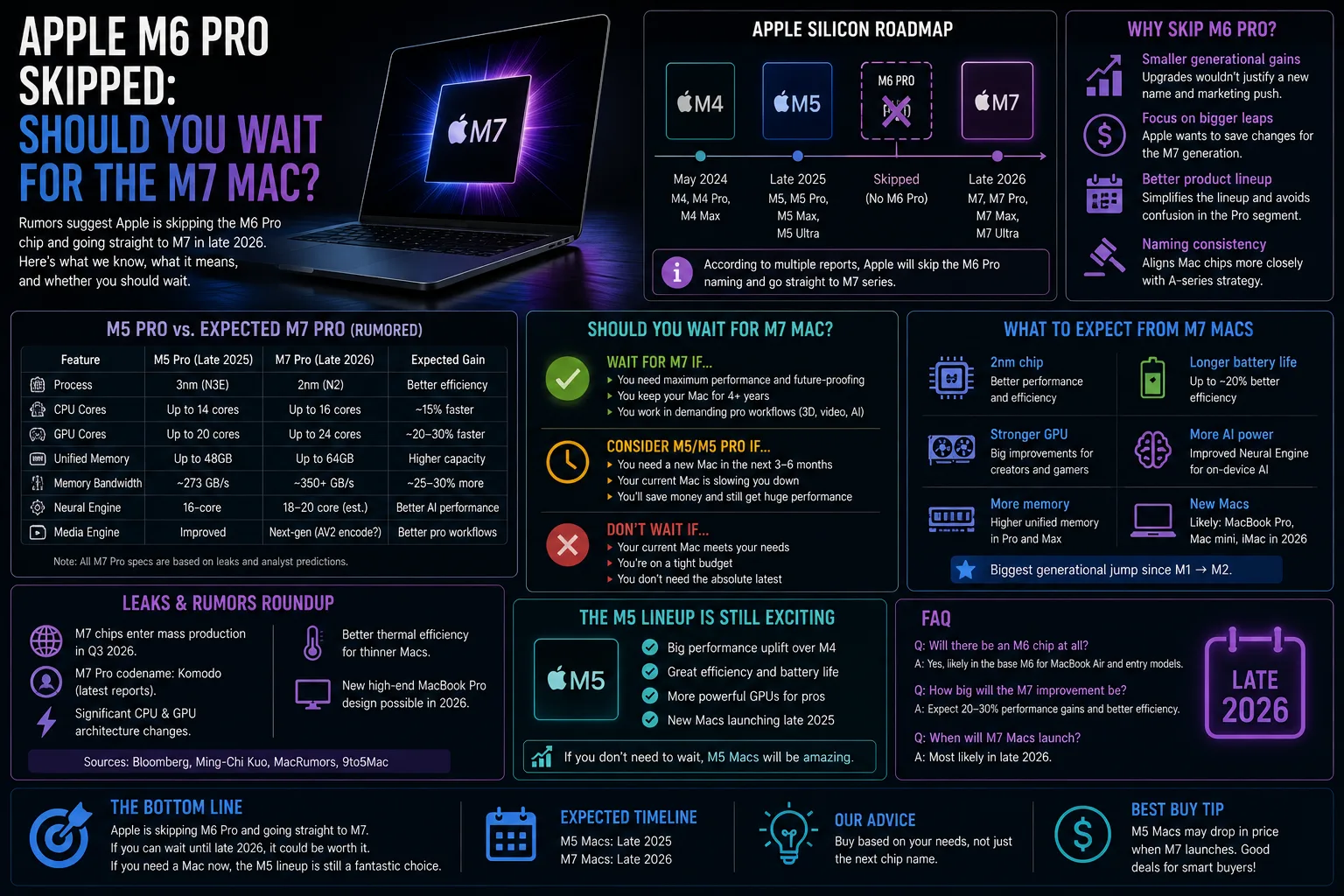
Apple is reportedly walking away from most of a chip generation. According to Bloomberg's reporting, the M6 Pro, M6 Max and M6 Ultra are being dropped so that engineering effort can move to M7, leaving the base M6 as the only member of the family to ship. The redesigned MacBook Pro arriving this autumn is said to carry M5 Pro and M5 Max instead. If you are trying to time a Mac purchase, that single decision changes the maths for the next 18 months.




What Apple is reportedly doing
- The base M6 ships as planned and becomes the only chip released from the M6 family.
- M6 Pro, M6 Max and M6 Ultra are skipped entirely.
- This autumn's redesigned MacBook Pro is expected to launch with M5 Pro and M5 Max.
- A base-model MacBook Pro in the older design is expected alongside it, using the base M6.
- M7 is pulled forward and could arrive as early as spring 2027, ahead of the usual autumn window.
Why AI is the reason behind it
Mark Gurman's account is specific: the M7 generation was already slated for major neural-engine work, and the M7 Ultra is where it goes into high gear, with a dramatic increase in AI performance that moves Apple closer to dedicated accelerators of the Nvidia Blackwell class. Skipping three chips to arrive there sooner only makes sense if Apple believes on-device AI performance is the axis its next few years of Mac sales turn on.

There is a second, quieter reason it makes sense. Apple's advantage in running local models has never really been raw neural throughput. It has been unified memory: a large pool addressable by the GPU and neural engine, which is what lets a Mac load a model that a discrete card with less VRAM simply cannot hold. A big neural-engine upgrade fixes the other half of that equation, and doing it a generation earlier is worth more than a complete M6 ladder.
What it means if you are buying a Mac
- Waiting for an M6 Pro or M6 Max machine is now waiting for something that will not exist. If you need a high-end laptop this year, the redesigned MacBook Pro with M5 Pro or M5 Max is the machine.
- That laptop's successor is an M7 Pro, so the gap between generations at the high end is longer than Apple's usual annual cadence. Expect a slower drop in resale value than normal, and a longer stretch as the current flagship.
- Base-tier buyers get the odd outcome: the newest chip in the oldest chassis. If the design matters less to you than the silicon, that entry MacBook Pro is arguably the better value.
- If you run local language models, the binding constraint today is how much unified memory you can afford, not which generation of chip you buy. Spending on memory now beats waiting for M7 with a smaller configuration.
- If AI workloads are the core of your job and you can wait into 2027, M7, and especially M7 Ultra, is the first genuinely different machine on this roadmap.


- ✓The redesigned MacBook Pro is available this autumn and will be the top laptop for longer than usual
- ✓No M6 Pro exists to make it look dated in twelve months
- ✓Memory capacity, not chip generation, is what limits local AI work today
- ✓M5 Pro and M5 Max are mature, well-understood silicon
- ·M7 is reportedly the generation where neural performance jumps, and it may arrive as early as spring 2027
- ·Buying the entry MacBook Pro means accepting the older chassis to get the newer base chip
- ·Apple has confirmed none of this, so the timeline can move
- ·Skipped tiers make chip names a poor guide to how current a Mac really is
How this breaks Apple's usual cadence

Since the first Apple silicon Macs, the pattern has been reliable: a base chip, then Pro, Max and eventually Ultra variants, refreshed on a roughly annual rhythm. Skipping tiers snaps that ladder. A Mac sold with an M5 Max in late 2026 and a Mac sold with an M6 weeks later are not what their numbers imply, and buyers comparing spec sheets across the range will find the naming actively misleading. It is worth remembering when you read a refurbished listing in 2027.
What to watch next
- Whether the autumn MacBook Pro launch confirms M5 Pro and M5 Max as reported
- Where the base M6 lands beyond the entry MacBook Pro, and whether the Air and iMac follow
- Any firming of the spring 2027 window for M7
- Memory bandwidth and neural-engine figures for M7 Ultra, which is where the reported gains concentrate
- Whether Apple starts marketing on-device AI performance in terms that invite comparison with dedicated accelerators
Is the M6 cancelled?
No. The base M6 is still expected to ship. The reportedly cancelled parts are the M6 Pro, M6 Max and M6 Ultra.
Will the new MacBook Pro be outdated quickly?
Less quickly than usual. It is expected to launch with M5 Pro or M5 Max, and because the M6 Pro tier is skipped, its replacement is an M7 Pro rather than an annual bump.
Should I wait for M7?
Only if local AI work is central to what you do and you can wait into 2027. For everything else, the practical performance of an M5 Pro or M5 Max machine is not the thing holding you back.
Does M7 mean Apple will beat Nvidia?
That is not the claim. The reporting describes M7 moving closer to the class of dedicated AI accelerators such as Blackwell, which is a gap-narrowing statement rather than a leapfrog.
Is unified memory still Apple's advantage for local models?
Yes. The amount of memory a model can occupy is usually what decides whether it runs at all, which is why configuring more unified memory beats waiting a generation.
Has Apple confirmed any of this?
No. This comes from Bloomberg's reporting on Apple's internal plans, and Apple does not comment on unreleased silicon. Roadmaps have changed before.