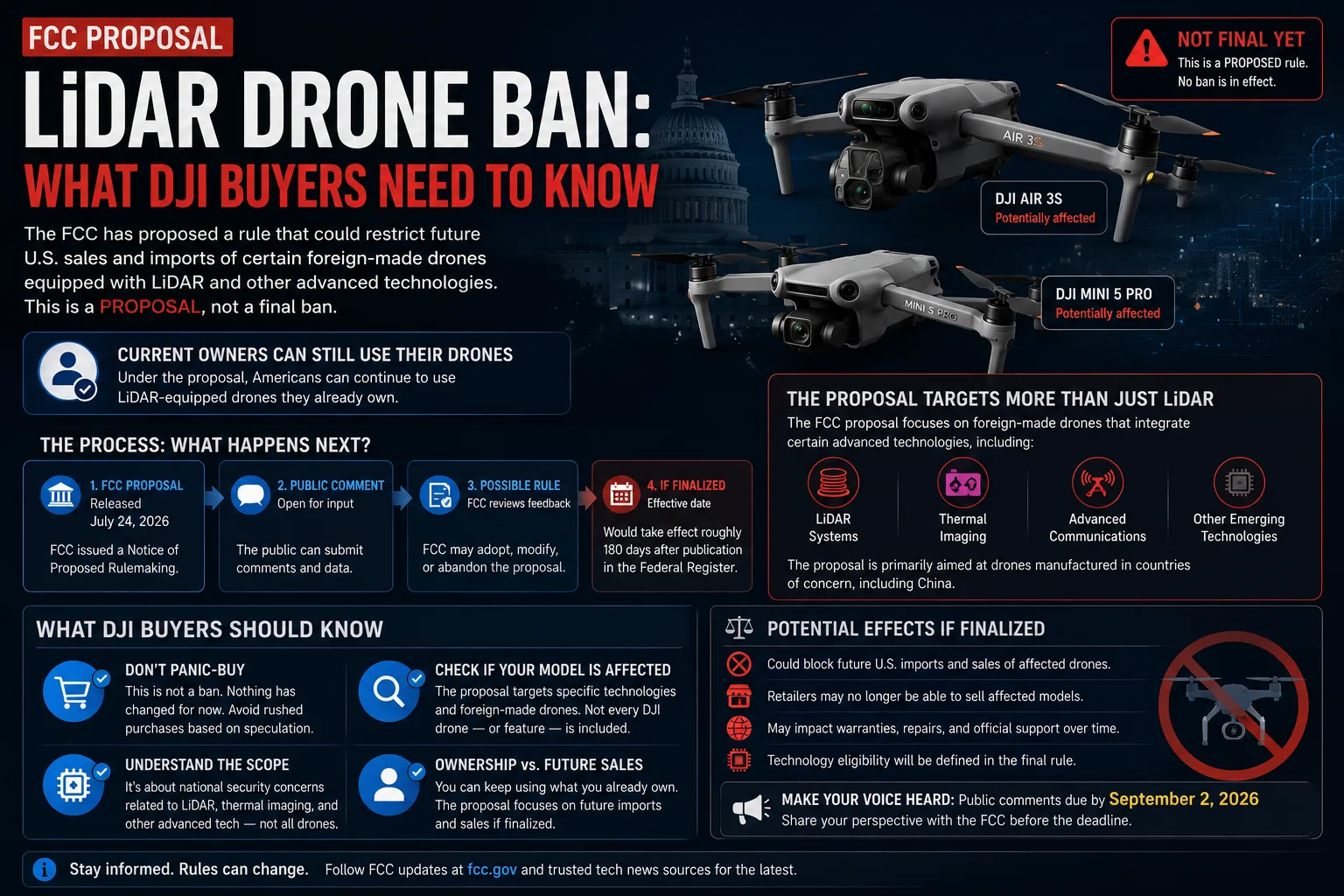
The FCC's drone crackdown used to be a problem for tomorrow's models. The agency's latest move changes that: a public notice posted in July asks for comment on extending its prohibition to whole categories of drone capability, including LiDAR sensing, thermal imaging and aerosol dispensing. Because the proposal is written around what a drone can do rather than when it launched, it can reach hardware the FCC itself already approved, and that is why consumer models such as the DJI Air 3S and Mini Pro 5 are suddenly part of the conversation.
What the FCC is actually proposing
The notice seeks comment on extending an existing prohibition to categories of drones the US government views as having military capability or as posing particular national security risks. Rather than naming individual models, it describes features. The capability list under discussion covers:
- LiDAR sensing
- Thermal imaging
- Aerosol dispensing
- Drones able to integrate defence articles
- Systems that rely on docking stations
- Swarming drones
That last pair is broader than it looks. Docking stations are standard on enterprise inspection fleets, and swarming is the technology behind commercial drone light shows, so a capability-based rule written for military risk would land on a lot of civilian equipment.
How we got here
- December 2025: the FCC added foreign-made drones and their critical components to the Covered List, its catalogue of communications equipment deemed to pose an unacceptable risk to national security. That change applied to upcoming models, so drones already authorised could still be sold.
- July 2026: the agency extended the ban to products from companies suspected of rebadging DJI hardware, closing the workaround of buying the same drone under a different brand.
- July 2026: the public notice at issue here opened the question of a capability-based expansion, the first step that could reach previously approved consumer drones.
Which drones could be swept in
The consumer models drawing attention are the ones that shipped LiDAR for obstacle avoidance and low-light landing, with the DJI Air 3S and Mini Pro 5 named in the coverage so far. Beyond those, thermal-camera variants sold to inspection and public-safety users, dock-based enterprise systems and swarm-capable show drones all sit inside at least one of the proposed categories. Nothing is decided: this is a request for comment, not a rule, and the final scope may be narrower than the notice.
Should you buy a DJI drone right now?
The honest answer depends on whether the sensor is a want or a requirement.
- Flying for fun with a drone you already own: nothing changes today, and nothing in the proposal targets you.
- Buying a non-LiDAR consumer model: unaffected by this particular capability list, though the December 2025 Covered List action still governs newly authorised foreign-made drones.
- Depending on LiDAR or thermal for paid work: this is the group with real exposure. Securing the airframe you need, plus batteries and spare payloads, removes the risk of a supply gap if the rule lands.
- Hoping to profit on resale: unpredictable. Scarcity can lift used prices, but so can a wave of owners selling before service and parts get harder to find.
- Watching the money: the practical near-term risk is not legality, it is thinner stock, slower spare parts and less certainty about long-term support.
What happens next
A public notice starts a comment cycle. Interested parties file comments, then reply comments, and only afterwards can the agency adopt an order that changes anything. Timelines slip routinely, and the scope can shrink between notice and order. DJI has issued a call to action urging pilots and operators to file, which is the one part of this process an individual buyer can actually influence: check the docket on the FCC's own site and submit during the window.
Why LiDAR became the trigger
LiDAR is dual-use in the most literal sense. On a consumer drone it measures distance so the aircraft can avoid a branch and land in the dark. Bolted to a mapping workflow, the same sensor produces precise three-dimensional models of terrain and structures, and paired with thermal imaging it starts to resemble reconnaissance kit. The proposal treats that combination as military-grade capability, which is a defensible national-security position and, at the same time, a rule that would catch a hobbyist filming a beach at dusk. That tension is what the comment period exists to resolve.
Can I still fly the DJI drone I already own?
Yes. The proposal targets authorisation for sale and import, and the FCC has said a new ban would not affect drones already with buyers. Registration, Remote ID and airspace rules are separate obligations and are unchanged by this notice.
Would a ban make my drone stop working?
Nothing in the proposal switches off existing hardware. The realistic consequences are commercial rather than technical: less stock, slower access to spare parts and more uncertainty about long-term service.
Is a Mini 4 Pro or another drone without LiDAR affected?
Not by this capability list, which is aimed at LiDAR, thermal imaging, aerosol dispensing, defence-article integration, docking stations and swarming. The earlier Covered List action still applies to newly authorised foreign-made models.
Is this a complete ban on DJI?
No. It is a proposal to widen an existing prohibition by capability. Separately, foreign-made drones and critical components went onto the Covered List in December 2025, and in July the agency extended action to suspected DJI rebrands.
Can I comment on the proposal?
Yes. Public notices take filings from anyone. Find the relevant docket on the FCC's website and file within the comment window; DJI has publicly asked pilots to do so.
Should I rush to buy before a decision?
Only if your work genuinely needs LiDAR or thermal imaging. For hobby flying there is no urgency, because current stock remains legal to buy, own and fly.