Vintage handhelds were designed in an era when nobody expected a device to sip power. The original Game Boy swallows four AA cells, a Game Gear takes six and empties them fast enough to feel like a running joke. The good news is that almost all of the problem is solvable with modern cells and a few habits, and none of the fixes below require you to modify a console you care about.
Why retro handhelds drain batteries so fast
Three things conspire against you. Early colour handhelds used cold-cathode backlights that draw far more current than any modern LED panel. There is essentially no power management inside these systems, so the console pulls what it pulls whether you are in a menu or a boss fight. And alkaline cells sag under sustained load, so the last third of their nominal capacity arrives as a dimming screen and a warning light rather than usable play time.
It also helps to know exactly what your system eats, because buying the wrong size is the most common mistake:
- Game Boy (original, DMG): four AA cells
- Game Boy Pocket: two AAA cells
- Game Boy Color: two AA cells
- Game Boy Advance: two AA cells
- Sega Game Gear: six AA cells
- Atari Lynx: six AA cells
Start with low self-discharge NiMH
For nearly everyone, a set of low self-discharge nickel-metal hydride cells is the whole answer. They are reusable hundreds of times, they cost less than alkalines within a couple of months of regular play, and they end the slow trickle of dead cells into the bin. Panasonic Eneloop is the reference choice for consistency and longevity, and IKEA LADDA is the popular budget alternative; the frequent claim that LADDA cells are rebadged Eneloops is speculation rather than confirmed fact. Both come in the AA and AAA sizes these consoles need.
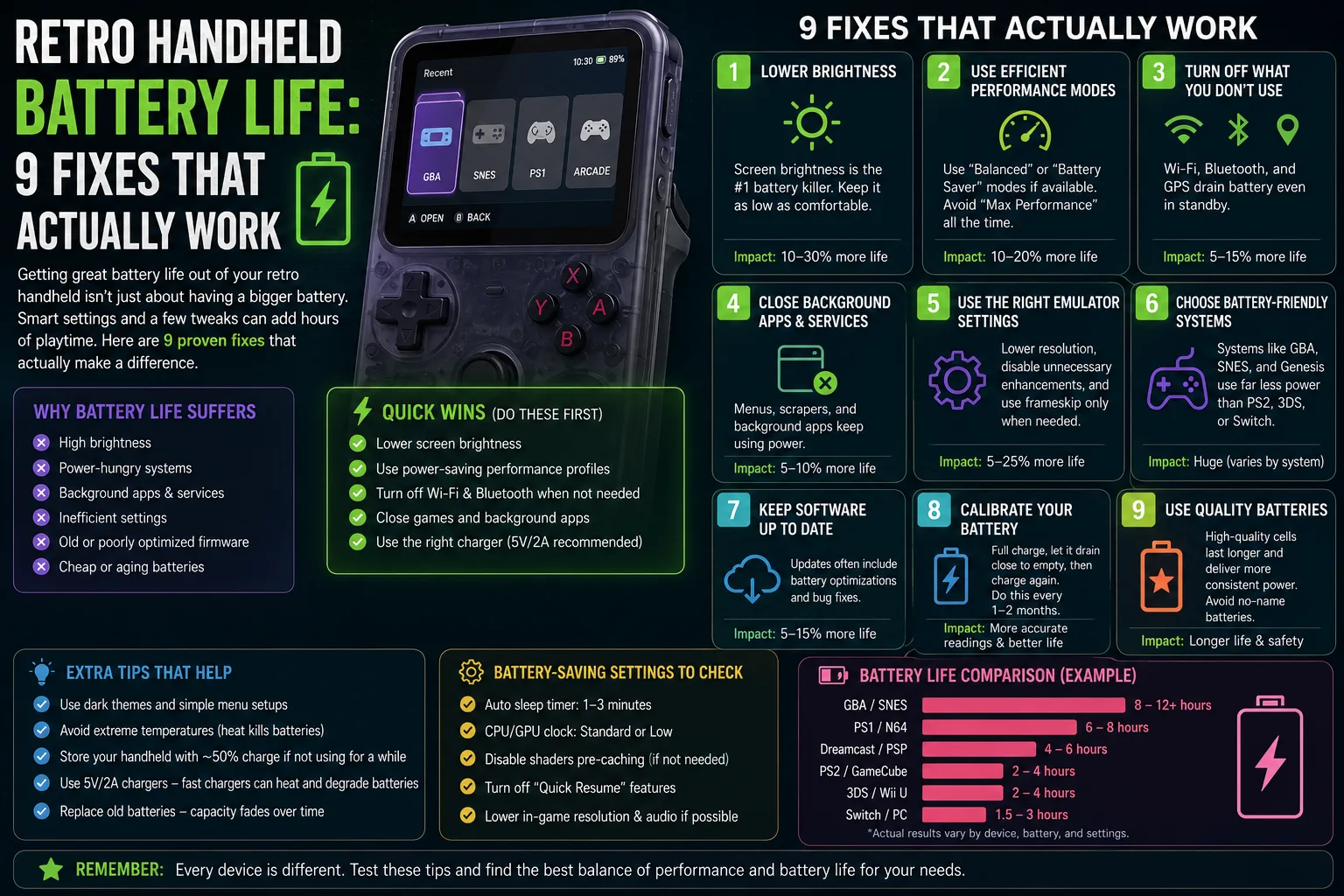
Nine fixes that actually work
- Buy low self-discharge NiMH in the correct size, and buy two sets so one is always charged.
- Use a smart charger that monitors each cell individually. Cheap paired chargers overcharge one cell while starving its neighbour, which is what kills sets early.
- Keep sets together and label them. Same brand, same age, same charge state, and never mix chemistries or capacities in one bay.
- Turn the backlight down or off wherever the system allows it. On an unlit Game Boy this is free; on a Game Boy Advance SP the low setting roughly transforms endurance.
- Drop the volume or use headphones. On the Game Gear and Lynx the speaker amplifier is a genuine load, not a rounding error.
- Fit a modern IPS screen kit if you play a Game Gear or Lynx regularly. Replacing a cold-cathode backlight with an LED panel is the single largest efficiency gain available to these consoles.
- Consider a purpose-made rechargeable pack for six-cell systems. Carrying six loose AAs to feed a console for three hours is the definition of diminishing returns.
- Store cells outside the console. Leaked alkaline is the leading cause of dead retro handhelds, and self-discharge is slower at room temperature than in a warm bag.
- Clean the battery terminals and the contacts in the bay. Corrosion adds resistance, and added resistance looks exactly like a failing battery.
What runtime to actually expect
Treat published figures as a starting point, not a promise, because capacity, volume, screen mods and cartridge draw all move the number. As a rough guide, an unlit original Game Boy on four decent AAs remains the endurance champion of the era and will run for the better part of a day of play. A Game Boy Advance on two AAs manages a long session rather than a long weekend. A Game Gear or Atari Lynx on six cells is measured in a handful of hours, which is precisely why a screen mod pays for itself in convenience. The point of switching to NiMH is not a headline number, it is repeatability: the same runtime every time, for years, without buying anything.
- ✓Far cheaper per hour of play than disposable alkalines
- ✓No leakage risk of the kind that destroys battery bays
- ✓Flat voltage under load, so no long fading tail
- ✓Hundreds of recharge cycles from a single set
- ✓Much less waste for anyone who plays weekly
- ·The low-battery indicator lights early because of the lower nominal voltage
- ·A decent charger is an upfront cost
- ·Cells self-discharge slowly over months in storage
- ·Very old, worn cells lose capacity and need replacing eventually
When a lithium conversion makes sense
For a Game Gear or a Lynx that gets played rather than displayed, a lithium conversion kit that replaces the cell bay with a rechargeable pack and a USB-C port is transformative: one cable, no loose cells, and a battery matched to the console's appetite. The caveats are real, though. Most kits need soldering, the quality of the protection circuit matters more than the advertised capacity, unprotected loose lithium cells have no place in a device that sits against your hands, and any irreversible modification reduces what an original console is worth later. If you are unsure, a NiMH set costs a fraction as much and can be undone by lifting a lid.
Can I still use alkaline batteries?
Yes, and for a console you play twice a year they are the sensible choice because they hold charge in storage. Just take them out afterwards; a leaking alkaline in a battery bay is how most retro handhelds die.
Will NiMH cells damage my console?
No. The lower voltage is well within what these systems tolerate, which is why they run normally on rechargeables. The only visible difference is an earlier low-battery warning.
Why does the low-battery light come on so soon?
Because it was calibrated for alkaline voltage. NiMH starts around 1.2 volts per cell rather than 1.5, so the threshold is crossed sooner even though usable charge remains.
Are IKEA LADDA cells really Eneloops?
That is a popular theory, not a confirmed fact. They are a well-regarded budget option in their own right, which is the part that matters for a Game Boy.
What about 1.5-volt lithium AA cells?
Primary lithium AAs hold a full 1.5 volts, weigh less and last a long time, so they suit a console you rarely play. They are not rechargeable and cost considerably more per hour, so they are a poor fit for regular use.
Can I just run it from a USB adapter at home?
For home play, a good-quality mains or USB adapter matched to the console's voltage and polarity works well and saves cells entirely. Check both figures against the console's own label before plugging anything in.