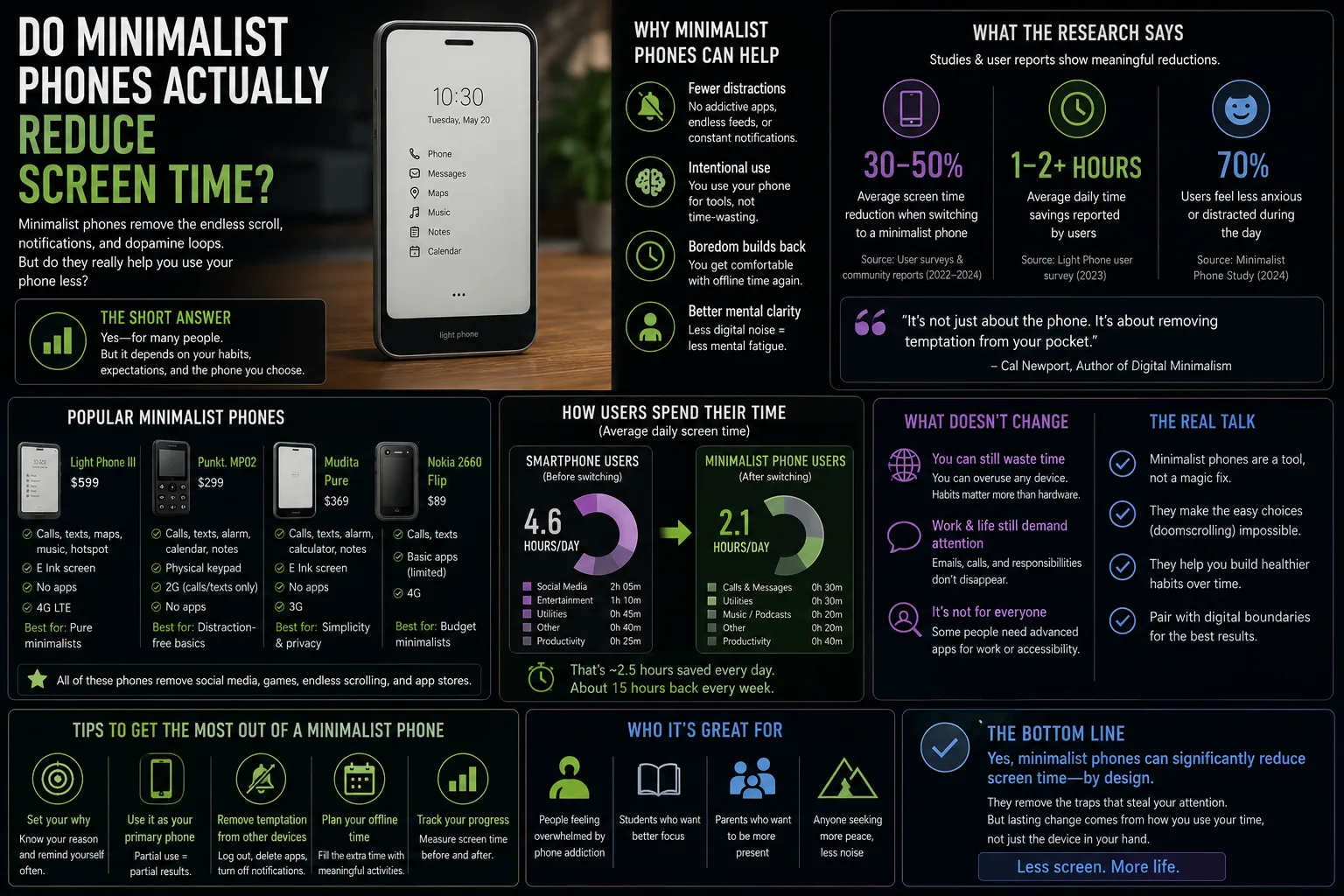
The minimalist phone category keeps growing. The Minimal Phone 2 pairs a QWERTY keyboard with an E Ink-style display and 5G, Clicks has built a business selling physical keyboards that deliberately shrink your screen, and a steady stream of "dumbphone" launches promises freedom from the scroll. The pitch is emotionally compelling. The evidence is more complicated.
Here is an honest look at what these devices do well, where they fall down, and the cheaper interventions worth trying first.
What a minimalist phone actually is
The category covers three fairly different things. True feature phones do calls, texts and little else. Hybrid devices run a stripped-back version of Android with a limited app launcher, often on an E Ink screen that makes video and social feeds physically unpleasant to use. And accessory approaches, like a snap-on physical keyboard, keep your existing phone but change its ergonomics and cover part of the display.
The mechanism in all three cases is friction. None of them make your apps unavailable in any absolute sense — they make reaching for them slightly annoying. Whether that is enough depends entirely on how strong the underlying habit is.
The options compared
| Approach | Cost | Friction added | Main drawback | Works best for |
|---|---|---|---|---|
| True feature phone | $50–$120 | Very high | No maps, banking or 2FA apps | Weekends and holidays |
| E Ink hybrid phone | $400–$700 | High | Slow, poor camera, expensive | Committed switchers |
| Physical keyboard accessory | $99–$140 | Moderate | Bulk; habit often adapts | Heavy typists |
| Second, stripped-down phone | $100 | Moderate | Two devices to manage | Evenings and weekends |
| Built-in focus settings | Free | Low to moderate | Easy to override | Almost everyone, first |
| Greyscale plus app removal | Free | Moderate | Requires self-enforcement | Trying before spending |
Try the free version first
Before spending several hundred dollars, run a two-week experiment that reproduces most of the effect at no cost. If this does not change anything, a new device probably will not either.
- Delete the apps, keep the accounts. Remove the social apps from your phone and access them only in a browser on a computer. This single change removes the majority of idle checking for most people.
- Turn the screen greyscale. Colour is doing more work than you think. Both iOS and Android can switch to greyscale in accessibility settings, and feeds become noticeably less compelling.
- Turn off all non-human notifications. Allow calls and messages from real people. Silence everything that is a machine asking for your attention.
- Move the phone out of the bedroom. Buy a cheap alarm clock. This is the highest-impact change and it costs about $15.
- Add a launch delay. Screen-time tools that insert a pause before an app opens break the automatic reach, which is the part you are actually trying to interrupt.
When a minimal phone genuinely helps
There is a real case for these devices, and it is narrower than the marketing suggests. They work best as a second device used deliberately — a feature phone taken on holiday, or used at weekends, while the smartphone stays home. The switch becomes a boundary you set once rather than a decision you make five hundred times a day.
They also work for people whose problem is genuinely the device rather than the accounts. If you find yourself opening a browser to check the same three sites regardless of which apps are installed, an E Ink screen that makes browsing genuinely tedious does something that willpower does not.
Why people go back
- Two-factor authentication. Banking, work logins and account recovery increasingly assume a modern smartphone. This is the most common practical dealbreaker.
- Maps and transit. Navigation on a feature phone is a real quality-of-life loss, particularly when travelling.
- Group messaging. Being the person who cannot see the photos or the group thread has genuine social cost.
- Payments and tickets. Contactless payment, boarding passes and event tickets are now largely phone-based.
- The camera. People underestimate how much they value casually photographing their own life until it is gone.
- Habit migration. The urge does not disappear; it relocates to a laptop, a tablet or a work computer.
What the underlying issue usually is
Compulsive phone checking is generally a response to something rather than a cause in itself — boredom, anxiety, avoidance of a difficult task, or simple habit strength built over years. Changing the hardware addresses the delivery mechanism, not the demand. That is why the honest version of this advice includes noticing when you reach for the phone, not just how often.
If your phone use is genuinely distressing you, or you have tried repeatedly to change it without success, that is worth discussing with a doctor or therapist rather than solving with a purchase. There is no shame in it, and it is a far better use of several hundred dollars.
Sleep is usually the highest-leverage place to start, because phone use and poor sleep reinforce each other. If you want to see whether changes are actually working, our reviews of the Oura Ring and the best running watches cover the trackers that measure sleep credibly rather than decoratively.
If you do want to buy one
- Check 2FA compatibility first for your bank, your employer and your email provider. Do this before ordering.
- Confirm your carrier's network bands, particularly on smaller-brand and imported devices.
- Set a trial period and keep your old phone until it ends. Do not sell it in week one.
- Choose it as an addition, not a replacement, at least initially.
- Be realistic about the camera. Every review of these devices reaches the same conclusion.
- Buy from somewhere with a genuine return policy. Crowdfunded hardware in this category has a mixed delivery record.
Minimalist phone FAQ
Do minimalist phones actually reduce screen time?
They can, particularly as a second device used deliberately. Results are inconsistent when used as a full replacement, because habits often migrate to laptops and tablets rather than disappearing.
What is the biggest problem with dumbphones?
Two-factor authentication. Banking, work systems and account recovery increasingly require a modern smartphone, and this is the most common reason people switch back.
Does greyscale mode help?
Many people report that removing colour makes feeds noticeably less engaging. It costs nothing to try and is a reasonable test of whether a device change would help.
Is an E Ink phone usable day to day?
For messaging, reading and calls, yes. Refresh rates make video, fast scrolling and photography poor, which is both the point and the limitation.
Are physical keyboard accessories worth it?
They appeal most to people who type a lot and want tactile keys. As a screen-time intervention the effect tends to fade as you adapt to the smaller display.
What should I try before buying one?
Delete social apps and use the browser instead, switch to greyscale, silence non-human notifications, and keep the phone out of your bedroom for two weeks.
Sources
- Manufacturer specifications for minimal and hybrid phone models
- Published research on habit formation and notification design
- The Verge
- Ars Technica
- Platform screen-time documentation from Apple and Google