A $100 smartphone in 2026 is a genuinely different proposition than it was five years ago. The floor has risen: 5G is standard, 4GB of RAM is common, and the screens are no longer painful to look at. But the compromises have also moved — they are now concentrated in places that are harder to spot on a spec sheet and much more annoying to live with.
What you actually get for $100 in 2026
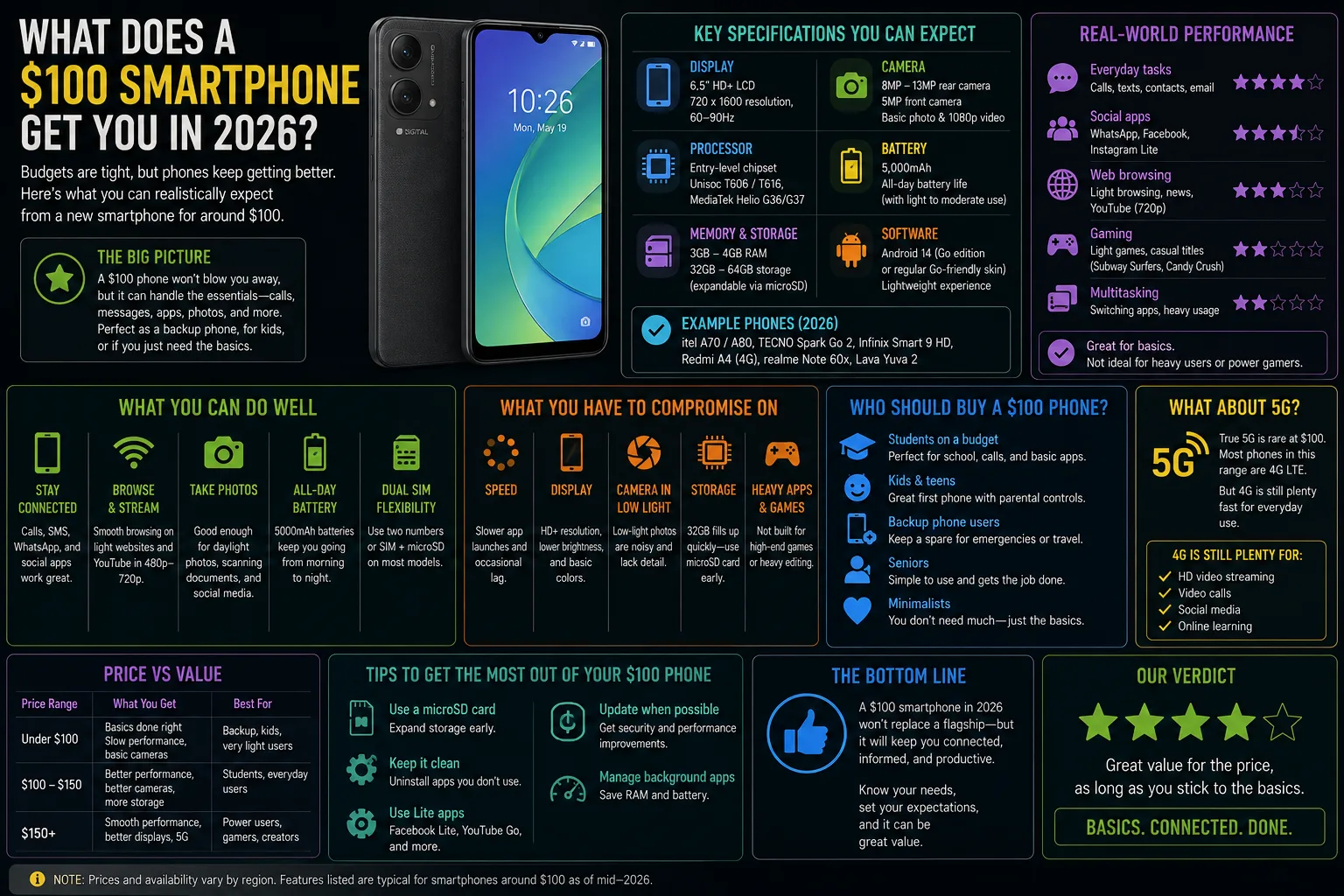
The hardware baseline at this price is more capable than the reputation suggests. Expect a 6.5-inch or larger LCD at 90Hz, an entry-level 5G chipset, 4GB of RAM with virtual RAM expansion, 64 or 128GB of storage with a microSD slot, and a large battery — often 5,000mAh, which frequently outlasts flagships because the components draw so little power.
What that translates to in daily use: messaging, calls, navigation, music, podcasts, banking apps and streaming video all work. Scrolling is mostly smooth. Web pages load. The phone does the things most people spend most of their time doing.
Where the money was saved
| Area | $100 phone | $300 phone | Does it matter? |
|---|---|---|---|
| Low-light photos | Poor | Acceptable | Yes — the biggest real gap |
| Software updates | 1–2 years, if any | 3–5 years | Yes, for security |
| Screen brightness outdoors | Struggles | Fine | Yes, in sunlight |
| App switching speed | Noticeable pauses | Smooth | Moderately |
| Battery life | Often excellent | Good | No — a genuine strength |
| Charging speed | 10–18W | 30W+ | Mildly |
| Build and water resistance | Plastic, minimal rating | Better | Depends on your habits |
| Preinstalled bloatware | Often heavy | Lighter | Yes — and removable in part |
The two compromises that actually hurt
Software support is the one to interrogate before buying. A phone that stops receiving security patches after a year is a liability, not a bargain, because it holds your email, banking and two-factor codes. Check the manufacturer's stated update commitment rather than assuming — the difference between brands at this price is enormous, and some now promise several years even on budget models.
Camera performance in low light is the other. Budget sensors are small and the processing is basic, so anything indoors or after sunset arrives noisy and smeared. In good daylight the results are honestly fine. If photos of your children indoors matter to you, this is the single strongest reason to spend more.
Who should buy a $100 phone
- A child's first phone. It will be dropped, lost or submerged. Spending $100 rather than $800 on that lesson is straightforwardly sensible.
- A travel or festival phone. Carry it instead of your main device where theft risk is high, and you lose very little if it disappears.
- A second line. Separating work and personal numbers without carrying a second expensive device.
- An older relative who wants calls, messages and photos. The performance ceiling is irrelevant for this use, and the large battery is a genuine benefit.
- Anyone whose phone use is genuinely light. If you mostly message and listen to podcasts, you are paying for capability you never touch on a flagship.
Who should not
- Anyone who takes photos as a primary use. This is where budget hardware is least forgiving.
- Mobile gamers. Entry-level chipsets throttle quickly and struggle with demanding titles.
- People who keep phones for five years. A $250 phone with a long update commitment is cheaper per year than two $100 phones with none.
- Anyone relying on it for work. The occasional stutter becomes genuinely costly when you are being paid for your time.
The smarter budget alternative
Before buying new at $100, compare against a two or three-year-old mid-range or flagship phone bought refurbished. An older premium device usually beats a new budget one on camera, screen and build quality — sometimes dramatically. The trade-off is remaining software support and battery health, so check both.
The same logic applies across Apple's range, which we cover in our guide to whether Apple refurbished is worth it. And if you are weighing a budget handset against the other end of the market, our comparison of the Galaxy Z Fold 8 and iPhone Ultra is a useful illustration of what an extra $1,700 actually buys.
How to buy well at this price
- Check the update policy in writing on the manufacturer's site, not in a retail listing.
- Look for 128GB rather than 64GB if the price gap is small — 64GB fills fast once photos accumulate.
- Verify the band support for your carrier before buying, especially on imported models.
- Avoid locked carrier models unless the subsidy is genuinely large.
- Read reviews of the specific model, not the brand. Quality varies wildly within budget ranges.
- Buy the phone, then a case immediately. Plastic bodies survive drops better than glass, but screens still crack.
Budget smartphone FAQ
Are $100 smartphones any good in 2026?
For messaging, navigation, streaming and calls, yes. The gaps are low-light photography, sustained performance and software update length rather than basic capability.
Do cheap phones get security updates?
It varies enormously by manufacturer. Some now commit to several years even on budget models while others provide little or nothing, so check the stated policy before buying.
Is a refurbished flagship better than a new budget phone?
Usually, on camera, screen and build quality. Check remaining software support and battery health, since those are where older premium devices fall short.
Do budget phones have good battery life?
Often excellent. Large batteries paired with low-power components and modest screens frequently deliver longer runtime than flagship devices.
Can you game on a $100 phone?
Casual and older titles run acceptably. Demanding modern games will run at reduced settings and the chipset will throttle under sustained load.
How long will a $100 phone last?
Physically, two to three years is realistic. The practical lifespan is usually decided by when security updates stop rather than by hardware failure.
Sources
- Manufacturer software update policy pages
- Android Authority
- The Verge
- GSMArena specification database
- Retailer pricing listings