Apple's Certified Refurbished store is the most consistently underrated way to buy Apple hardware, and it is quietly becoming more relevant as component costs push new prices upward. The catch is that "refurbished" means something very specific here, and it is not the same thing as refurbished from a marketplace seller or a carrier.
Here is what you are actually getting, where the savings are best, and when buying new or last-generation is the smarter call.
What Apple Certified Refurbished actually means
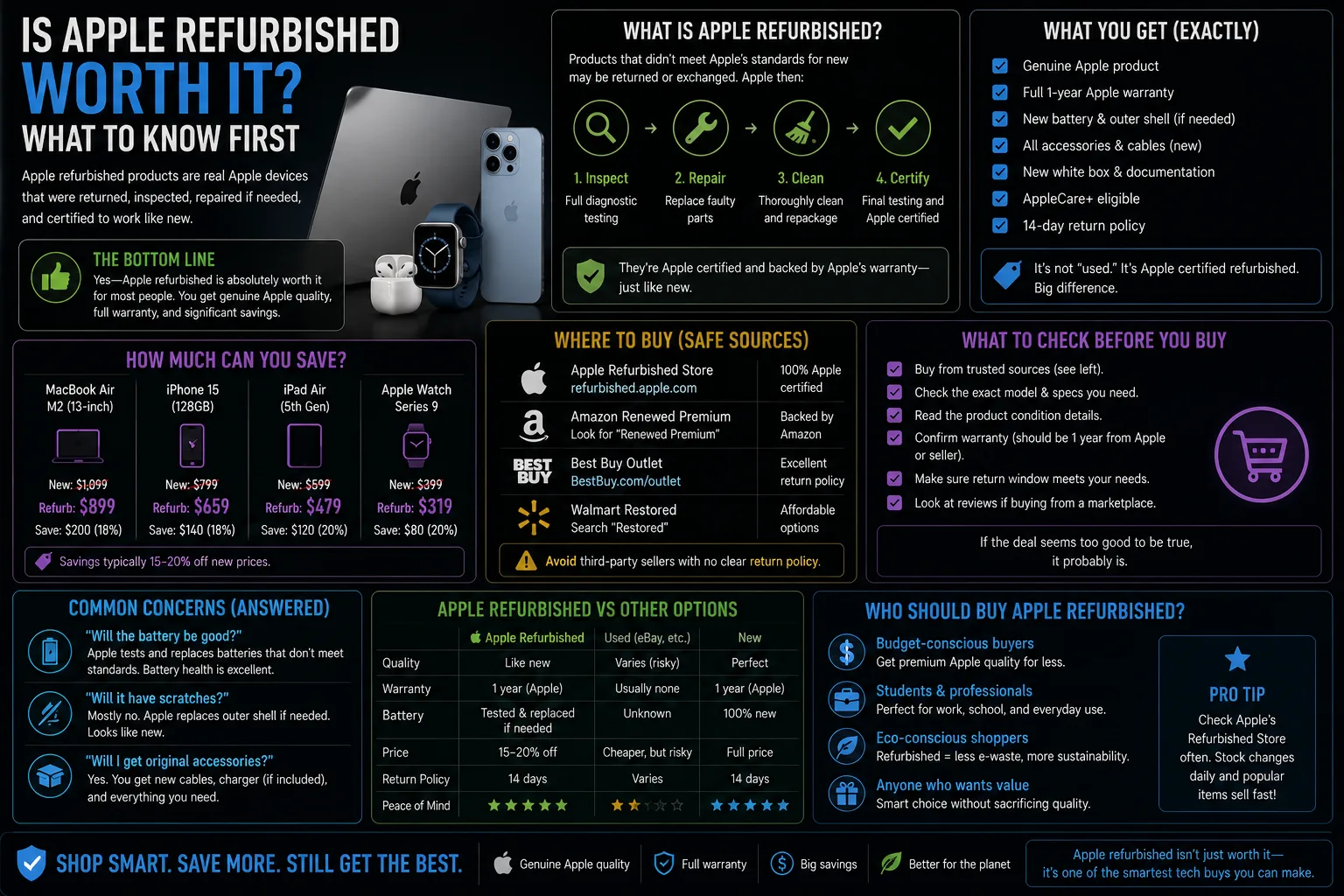
Apple's own refurbishment process is deliberately conservative. Units are fully tested, any failed components are replaced with genuine parts, and the device is repackaged in a plain white box with the accessories and cables you would get with a new unit. Critically, iPhones, iPads and Apple Watches receive a new battery and a new outer enclosure, which means the device you receive looks and feels new rather than second-hand.
The warranty is the part people underestimate. Certified Refurbished comes with the same one-year limited warranty as new hardware, and it remains eligible for AppleCare. That combination is what separates it from every other refurbished channel — the risk profile is essentially identical to buying new.
Refurbished buying options compared
| Source | Typical saving | Warranty | New battery | Risk |
|---|---|---|---|---|
| Apple Certified Refurbished | 15–25% | 1 year, AppleCare eligible | Yes, on most devices | Very low |
| Carrier refurbished | 20–40% | Varies, often 90 days | Not guaranteed | Moderate |
| Major retailer open-box | 5–15% | Retailer policy | No | Low |
| Third-party refurbishers | 25–45% | Varies widely | Sometimes | Moderate to high |
| Marketplace private sale | 30–50% | None | No | High |
| Apple last-generation new | 10–20% | 1 year | Yes | Very low |
Where the refurbished store is best value
- Macs, especially higher-configuration models. This is the strongest category by a wide margin. Custom-configured machines with more memory or storage frequently appear at prices well below a comparable new build, and the specification premium Apple charges on new orders is exactly what you avoid.
- iPads. A steady supply of previous-generation models, and iPads age slowly enough that a one-generation-old tablet remains fully capable for years.
- Apple Watch. New enclosure and battery makes this feel like a new purchase, and watch hardware changes modestly year to year.
- Displays and accessories. Low turnover, minimal technology risk, decent discounts.
- Less compelling: iPhones. Stock is thin, discounts are modest, and carrier or trade-in deals on new models often beat the refurbished price outright.

How to actually get what you want
The refurbished store's weakness is availability. Inventory is whatever has come back through returns and repairs, so the configuration you want may not exist today and may appear tomorrow. A few habits make a real difference.
- Check daily, or use a stock-tracking alert service. Popular configurations sell within hours.
- Shop shortly after a new product launch. Return windows from the previous generation close, and stock arrives in waves.
- Decide your specification in advance. When the right unit appears you have minutes, not days, and indecision costs you the unit.
- Compare against the equivalent new education price if you qualify — sometimes it is closer than you expect.
- Check the return window. Apple's standard return policy applies, which gives you a genuine trial period.
When to buy new instead
Refurbished is not automatically the answer. If a major redesign or a significant chip generation is imminent, a small refurbished discount on outgoing hardware is poor value compared with waiting. That calculation matters more than usual right now, since memory and component costs are pushing across the whole industry — the same pressure that made graphics card pricing in 2026 so erratic, and that is driving the Nintendo Switch 2 price increase.
Buy new if you need a specific configuration on a deadline, if you want the current generation's headline feature, or if a trade-in or carrier promotion closes the gap. Buy refurbished if you are flexible on configuration and want the best price-to-risk ratio available.
What to check when it arrives
Refurbished units are reliable, but a ten-minute check on arrival is sensible with any hardware purchase.
- Verify the serial number on Apple's coverage page to confirm the warranty start date.
- Check battery health in settings on portable devices.
- Run a display test on a plain white and plain black background to spot dead pixels or uniformity issues.
- Confirm all ports, speakers, cameras and wireless radios work before the return window closes.
- Make sure the device is not activation-locked to a previous owner — it should not be from Apple, but check.
If you are replacing an older machine, wipe and dispose of the old one properly. Our guide to wiping storage before you throw it away covers the principle that applies to any drive leaving your hands.
Apple refurbished FAQ
Is Apple Certified Refurbished as good as new?
Functionally, close to it. Units are fully tested with genuine replacement parts, come with a one-year warranty, are AppleCare eligible, and most portable devices receive a new battery and outer casing.
How much do you save buying Apple refurbished?
Typically 15 to 25 percent off the original new price, with larger effective savings on high-specification Macs where Apple's configuration upgrades are expensive when bought new.
Does Apple refurbished come with a warranty?
Yes — the same one-year limited warranty as new hardware, and you can add AppleCare coverage.
Do refurbished iPhones get a new battery?
Apple replaces the battery and outer shell on refurbished iPhones, iPads and Apple Watches, so the device should arrive at full rated battery capacity.
Why is stock so limited?
Inventory comes from returns and repaired units rather than production runs, so availability is unpredictable and popular configurations sell quickly.
Is third-party refurbished cheaper?
Often yes, sometimes considerably. The trade-off is inconsistent warranty terms, non-genuine parts in some cases, and no AppleCare eligibility.
Sources
- Apple Certified Refurbished store terms and warranty documentation
- Apple return policy pages
- 9to5Mac
- MacRumors
- Consumer warranty guidance