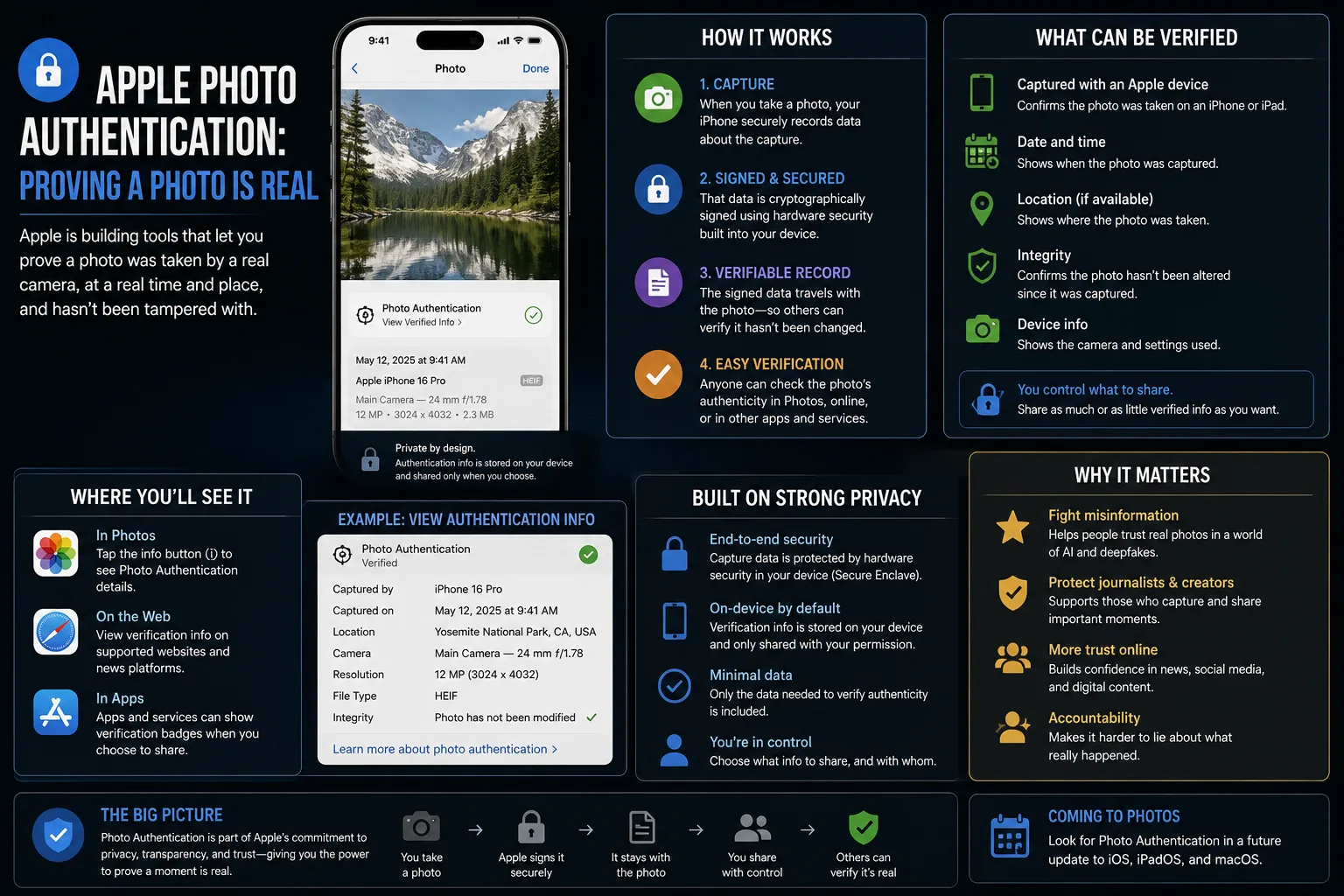
Buried in the fifth beta of iOS 27 are references to a feature that could matter more than anything Apple has put on a keynote slide this year. Code strings point to a tool — described in the references as a reference image — designed to certify that a photograph was captured by an iPhone camera rather than generated, composited or edited elsewhere. Apple has not announced it, and it may never ship. But the problem it addresses is not going away.
What photo authentication actually means
Provenance systems do one narrow job: they attach a cryptographically signed record to an image at the moment of capture, then let anyone check later whether the file still matches that record. If the pixels are altered, the signature breaks. If the file was never signed in the first place, there is nothing to check.
This is the model behind the industry's Content Credentials work, which several camera makers and software companies have been slowly adopting. Apple building it into the iPhone camera would matter simply because of scale: the iPhone is the most widely used camera on earth, and a standard nobody uses is not a standard.
Why now
Generative image tools have crossed the threshold where a convincing fake costs nothing and takes seconds. The practical consequence is not that people believe fakes — it is that people stop believing real photographs. Insurance claims, marketplace listings, dating profiles, court evidence, news photography and even a landlord's damage deposit dispute all rest on the assumption that a photo is a record of something that happened.
Once that assumption is gone, the only replacement is verifiable provenance. Apple has spent several releases pushing generative editing tools into Photos, and it is consistent for the company to also ship the counterweight: a way to say "this one came straight off the sensor". You can see the wider direction of travel in everything new in iOS 27.
What it could and could not prove
| Question | Can provenance answer it? |
|---|---|
| Did this file come from an iPhone camera? | Yes, if signed at capture |
| Has the file been altered since capture? | Yes |
| Is the scene in the photo real? | No — you can photograph a screen or a printed fake |
| Is the caption or context accurate? | No |
| Was an unsigned photo faked? | No — absence of a signature proves nothing |
| Where and when was it taken? | Only if that metadata is included and preserved |
That fifth row is the one that will cause trouble. If verified photos become the norm, unverified ones start to look suspicious by default — including every picture taken on an older phone, a film camera or any device that never signed anything. Provenance systems work as a positive signal and fail badly as a negative one.
The weak link is everything after capture
Signatures survive only if the file does. Most social platforms strip metadata on upload, re-encode images and resize them, which breaks the chain almost immediately. Screenshots destroy it. Messaging apps that compress aggressively destroy it. A provenance system is only as useful as the number of places that bother to preserve and display the credential.
This is why the standard matters more than the feature. If Apple signs images in a format that platforms already read, the feature is meaningful the day it ships. If it signs them in something proprietary, it is a curiosity that works between iPhones.
What to do about photo trust today
- Keep originals. The unedited file straight from the camera roll is your evidence; exports and screenshots are not.
- Do not rely on metadata alone. EXIF fields are trivially editable and prove nothing on their own.
- For anything with money attached — insurance, sales, damage disputes — take several photos from different angles at the same time, and keep them in one album.
- Send full-resolution files rather than compressed chat versions when a photo needs to hold up later.
- Treat a missing credential as neutral information, not as evidence of a fake.
The privacy question nobody has answered yet
A signature that proves which device took a picture is, by definition, a link between an image and a piece of hardware. Done carefully, that link identifies a device class and nothing more. Done carelessly, it becomes a way to tie an anonymous photograph to an individual — a genuine problem for photojournalists, whistleblowers and anyone documenting something risky. Apple has generally designed these systems to avoid unique identifiers, but the detail will only be knowable when the feature is documented rather than inferred from beta code. It is worth remembering that Apple's privacy features occasionally behave differently in practice than in the marketing, as our piece on the iCloud Private Relay IP leak showed.
When we might see it
Nothing here is confirmed. Code references in a beta indicate work in progress, not a shipping date, and Apple regularly removes things between beta five and release. The realistic outcomes are a quiet appearance in a later iOS 27 point update, a full announcement alongside next year's iPhones, or nothing at all. Treat any specific date you read as speculation.
Apple photo authentication FAQ
Has Apple confirmed a photo authentication feature?
No. The evidence is code references found in the fifth iOS 27 beta by developers and reporters. Apple has made no announcement, and beta references sometimes lead nowhere.
What is a reference image in this context?
It is the name that appears in the beta code for a record created at capture that can later be used to check whether an image came from the iPhone camera and has not been altered.
Would this stop AI-generated fakes?
Not directly. It would let a genuine photo prove its origin. A fake simply would not carry a credential, which is only useful once people expect to see one.
Does photo provenance survive being posted on social media?
Often not. Many platforms strip metadata and re-encode images, which breaks the signature. Adoption by platforms is what decides whether the feature is useful.
Can I verify photo authenticity today?
Partly. Some cameras and editing tools already embed Content Credentials, and there are public tools for inspecting them, but coverage is patchy and absence of a credential means nothing.
Would this work on older iPhones?
Unknown. Features that involve the camera pipeline and the secure enclave often require newer hardware, but nothing about device support has been confirmed.
Sources
- Engadget: Apple may introduce a photo authentication tool in iOS 27
- 9to5Mac: Apple is working on a way to authenticate that a photo came from an iPhone camera
- MacRumors: everything new in iOS 27 beta 5