In August 2026 the cloud version of Aliens: Fireteam Elite on Nintendo Switch stopped working. Not "lost matchmaking" — stopped. The servers that streamed the game were switched off by the developer, and the people who paid for it were left with a store entry that no longer launches anything. No refunds were offered.
A few days earlier, a Battlefield 6 player with more than 400 hours logged reportedly received a full Steam refund after modes he had bought the game for were removed. Two stories, one uncomfortable question: when you buy a digital game, what exactly did you buy?
What you actually buy on a digital storefront
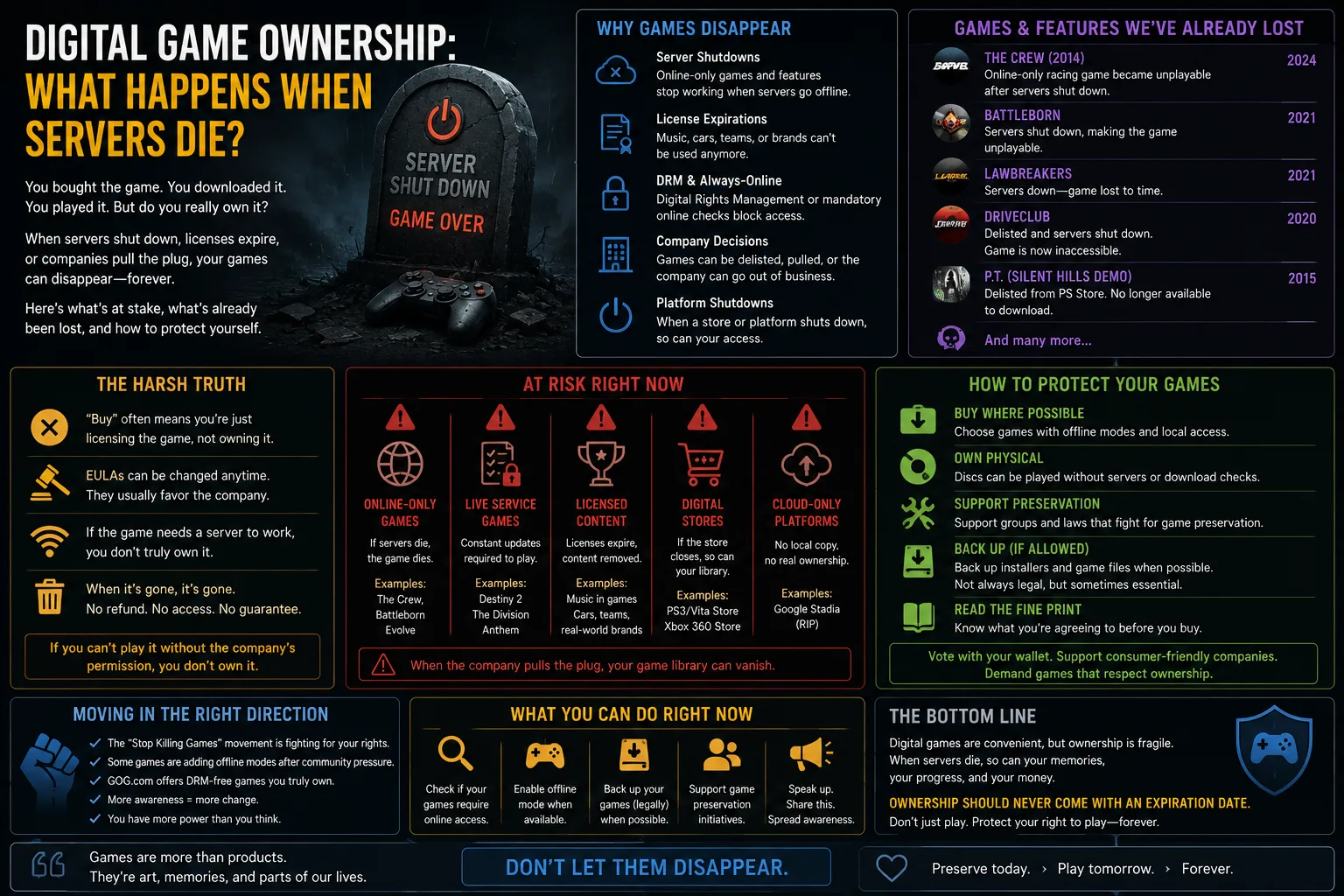
Every major platform — Steam, the Nintendo eShop, the PlayStation Store, the Microsoft Store — sells a licence to access software, not ownership of a copy. The wording differs, the substance does not. The licence can be limited by time, by region and by the continued existence of the servers that authenticate or deliver the game.
For most purchases this is an academic distinction. You download a game, it lives on your drive, and it keeps working. The distinction stops being academic in three specific cases: games that require an online check to launch, games whose content lives on a publisher's servers, and cloud or streaming versions where nothing was ever downloaded at all.
Why cloud versions are the most fragile purchase in gaming
Cloud versions exist because some games are too demanding for the hardware they are sold on. Instead of shipping a cut-down port, the publisher streams the full game from a data centre. The Switch has hosted several of these, and the arrangement works well right up to the moment the streaming contract ends.
When that happens there is no offline fallback, because there was never a local copy. This is what separates the Fireteam Elite situation from an ordinary server shutdown: with a normal game, losing multiplayer leaves the campaign intact. With a cloud version, the shutdown removes everything, including any single-player content you paid for.
Digital vs physical vs cloud: how fragile is each?
| Format | Works after servers shut down? | Main risk |
|---|---|---|
| Physical disc or cartridge with full game on media | Yes, offline | Damage, loss, drives disappearing from consoles |
| Physical release that is really a download key | No, once the key servers close | Marketed as physical, functionally digital |
| Standard digital download | Usually yes, if it runs offline | Store closure, account bans, always-online DRM |
| Live-service digital game | No | Content removal, sunset announcements |
| Cloud / streaming version | No | Total loss with no local copy |
Refunds: what the stores will and will not do
Refund policies were written for buyer's remorse, not for a game disappearing three years later. Steam's well-known window covers roughly two weeks and two hours of play; console stores are generally stricter and often refuse once a title has been downloaded. That is why the Battlefield 6 case attracted attention — a refund granted far outside the normal window suggests support staff have discretion when a purchase materially changes after the fact.
The practical advice: ask anyway. Support agents can and do issue exceptions when the complaint is "the thing I bought no longer exists" rather than "I did not enjoy it". Be specific, be calm, cite the shutdown announcement, and state clearly what was removed.
How to protect yourself without giving up digital
- Prefer versions that install locally. If a game offers both a cloud version and a native port, take the port even at a lower resolution.
- Check whether a "physical" release contains the game or only a download code. The back of the box usually says.
- Back up your saves. Cloud saves vanish with the service; local backups do not.
- Buy live-service games close to the moment you will play them, not in a sale years ahead.
- Keep the purchase receipt and the shutdown notice together if you plan to request a refund.
- For older hardware, keep a device that can still run what you own — the same logic behind keeping a retro handheld alive, which we cover in our guide to retro handheld battery life.
Where consumer law actually helps
This varies enormously by country, and none of it is legal advice. In several jurisdictions, digital goods sold as permanent purchases carry an implied expectation that they remain usable for a reasonable period, and regulators in Europe and Australia have previously taken storefronts to task over refund practices. If a store refuses and you believe the product was misrepresented, the escalation path is usually your national consumer protection body or, for card purchases, a chargeback.
What is changing is the labelling. Pressure from regulators and campaigns has already pushed some storefronts toward clearer wording about licences and toward warning buyers when a game requires servers that may be switched off. Expect more of that, not less.
Why this keeps happening
Streaming and live-service models shift the cost of running a game from the buyer to the publisher, permanently. A disc costs the publisher nothing after it ships. A cloud version costs money every single day it stays online. When a title stops earning enough to cover that, the rational business decision is to switch it off — which is exactly what keeps happening, and exactly why "digital ownership" now has an expiry date attached that nobody prints on the store page.
Digital game ownership FAQ
Do I own the digital games I buy?
You own a licence to access them. Every major storefront sells access under terms that allow the licence to end, most obviously when the servers required to run or authenticate a game are shut down.
Can I get a refund if a game becomes unplayable?
There is no guarantee, but it is worth asking. Refunds outside the standard window are granted at the store's discretion, and a documented shutdown is a much stronger argument than dissatisfaction.
Are cloud versions of games worse value than normal downloads?
They are more fragile. Nothing is stored on your console, so when the streaming service ends there is no offline fallback and no partial access to single-player content.
Does buying physical protect me?
Only if the media contains the game. Many "physical" releases are boxes with a download code, and some discs install a small launcher that still needs online content to work.
What happens to my games if a console store closes?
Titles already downloaded generally keep working, though re-downloading may become impossible. Games that require an online licence check are the ones at real risk.
How can I tell if a game needs servers to run?
Look for an online requirement on the store page, check whether the game has a single-player mode that works offline, and search the title alongside terms like "offline" or "always online" before buying.
Sources
- Ars Technica: players lose access to Aliens: Fireteam Elite on Nintendo Switch without refunds
- IGN: Aliens: Fireteam Elite Switch servers shut down with no refunds offered
- Video Games Chronicle: cloud version shutdown coverage
- IGN and Eurogamer: Battlefield 6 player granted a Steam refund after mode removal
- Polygon: analysis of the precedent set by the refund