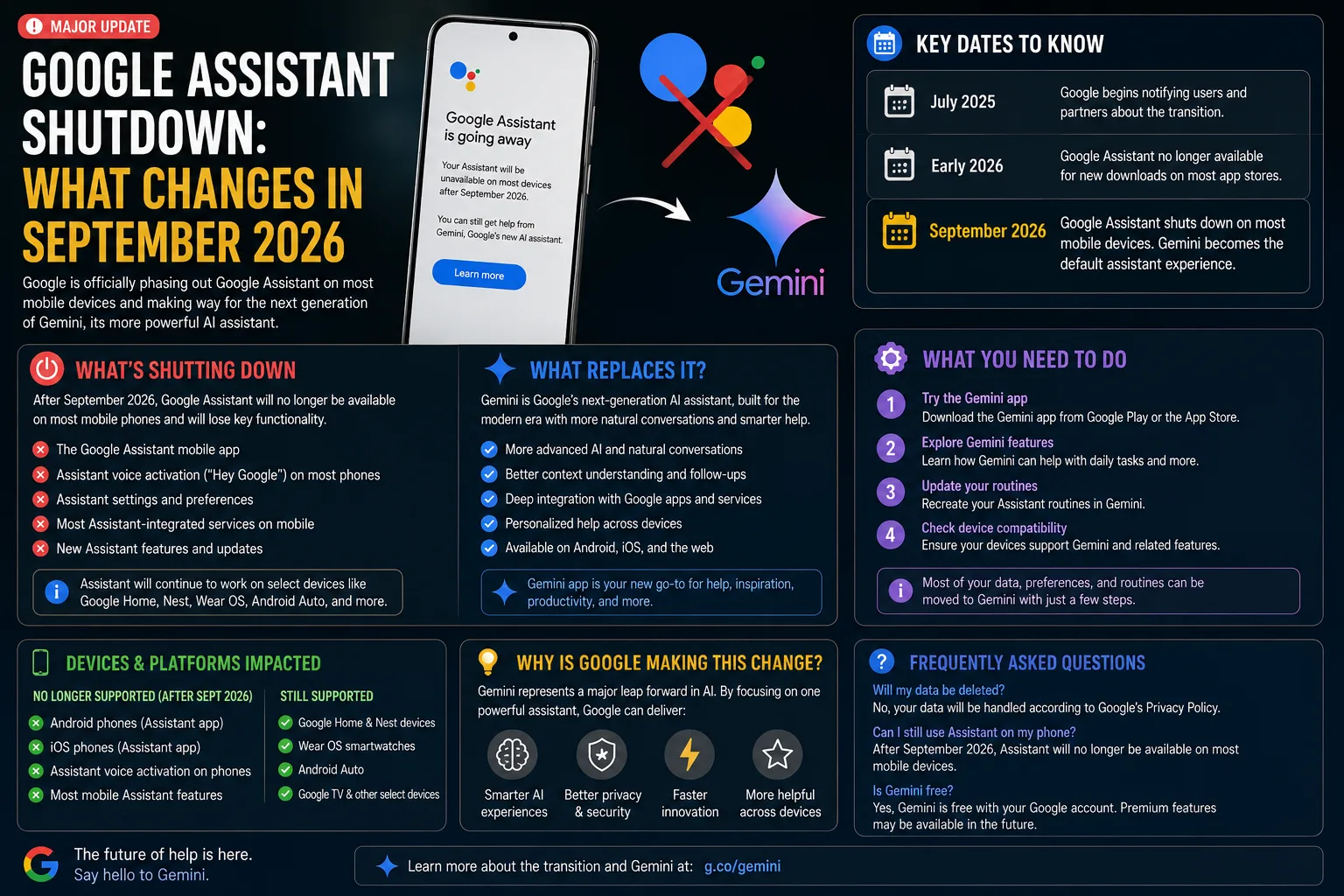
Google Assistant is going away for good. Google is retiring the assistant on Android phones and Wear OS watches in September 2026 and handing voice duties to Gemini, with Engadget, 9to5Google and Ars Technica all pointing to 4 September for the phone rollout. If you have spent years building routines, setting kitchen timers by voice or leaning on your watch for hands-free reminders, this is the change that will actually show up in your day.

Why is Google Assistant shutting down?
Assistant is being retired in favour of Gemini, Google's language-model assistant, because Google no longer wants to maintain two voice systems in parallel. The handover has been staged rather than sudden: Gemini first appeared on Android as an opt-in, then became the default for most people, and now the older assistant is being removed instead of kept alongside it.
That final step is the one that stings. Until now you could fall back to Assistant whenever Gemini misread a command. After September, on affected devices, there is no fallback left.
When does Google Assistant shut down?
September 2026 is the window every outlet reports, and 4 September is the date attached to the Android phone rollout. Treat the exact day as provisional until Google confirms it in its own words. Staged rollouts almost always mean some accounts lose the old assistant days or even weeks after others, so plan around the month rather than the date.
| Platform | Reported timing | What to expect |
|---|---|---|
| Android phones | September 2026 — 4 September reported | Assistant removed; Gemini becomes the only assistant |
| Wear OS watches | September 2026 | Hands-free voice control moves to Gemini |
| Nest speakers and displays | Separate, slower rollout | Gemini arrives device by device, not on the phone timetable |
Which devices are affected?
- Android phones. The headline change, and the only one with a specific September date attached so far.
- Wear OS watches. Named directly in the shutdown reporting. That matters more than it sounds, because the watch is where most people use voice control without thinking about it.
- Nest speakers and smart displays. These have been moving to Gemini on their own, slower timetable, so do not assume every device in your home changes on the same day.
Older hardware is the wildcard. A conversational assistant asks more of a device than a command parser does, so if you are running a budget phone or an ageing Wear OS watch, test how quickly Gemini responds now rather than assuming parity.
Gemini vs Google Assistant: what you gain and what you lose
Where Gemini is clearly better
Gemini handles everything Assistant was bad at: open-ended questions, follow-ups that depend on what you just said, summarising, drafting and anything that needs context rather than an exact command phrase. If you have ever given up halfway through explaining something to Assistant, most of that frustration disappears.
Where Assistant still wins
The trade is speed and predictability. Assistant was a command parser, and command parsers are fast and boringly consistent: a timer was a timer, every time, in the same number of seconds. A model-based assistant is more capable and less deterministic, and on short utility tasks that difference shows up as latency and the occasional unnecessary explanation. Whether the swap feels like an upgrade depends entirely on which of those two jobs you ask for more often.
| Everyday task | Google Assistant | Gemini |
|---|---|---|
| Timers and alarms | Instant and identical every time | Reliable, but usually slower to respond |
| Smart home commands | Fast and literal | Improving, occasionally chatty |
| Open-ended questions | Frequently gave up | Much stronger |
| Follow-up questions | Poor | Handles context well |
| Weak signal or offline | Some commands resolved locally | More dependent on a connection |
Why Android users are pushing back
The reaction has not been quiet. TechRadar covered a wave of frustration from long-time Android and Pixel owners, including people saying their current phone will be their last, and the complaints cluster around reliability rather than ambition. Routines that used to fire without thinking, quick smart-home commands and low-signal behaviour are exactly the things people notice when they change. Forced migrations also remove the option to simply wait, which tends to turn mild irritation into something louder.
What to check before September
- Audit your routines. Open the ones you actually rely on, note what each one triggers, and test the Gemini equivalent now rather than at 7am on a weekday.
- Run your five most-used commands. Most people have a handful they repeat constantly. Say them to Gemini and see which ones behave differently.
- Test your watch. Wear OS voice control is the easiest thing to forget until it stops working the way you expect.
- Check the whole household, not just your phone. Anyone else who uses your speakers or displays will hit the same change without having read about it.
- Report what breaks. Feature-parity gaps get closed faster when they are reported during a migration than after it.
Can you keep using Google Assistant?
Not on affected devices once the shutdown reaches your account. Google is removing Assistant rather than leaving it as a toggle next to Gemini, so there is no supported way to stay on the old assistant. If one specific Assistant behaviour is critical to you, the realistic options are to rebuild it as a Gemini routine, move it to a third-party app, or go back to doing it by hand.
What the shutdown says about voice assistants
This is the end of a particular idea of what a voice assistant is. Assistant belonged to the era of fixed commands and predictable responses; Gemini belongs to the era of conversation. The first is easier to trust for small tasks, the second is far more useful for everything else. Google has decided it cannot maintain both, and September is where that decision becomes real for everyone still on the old one.
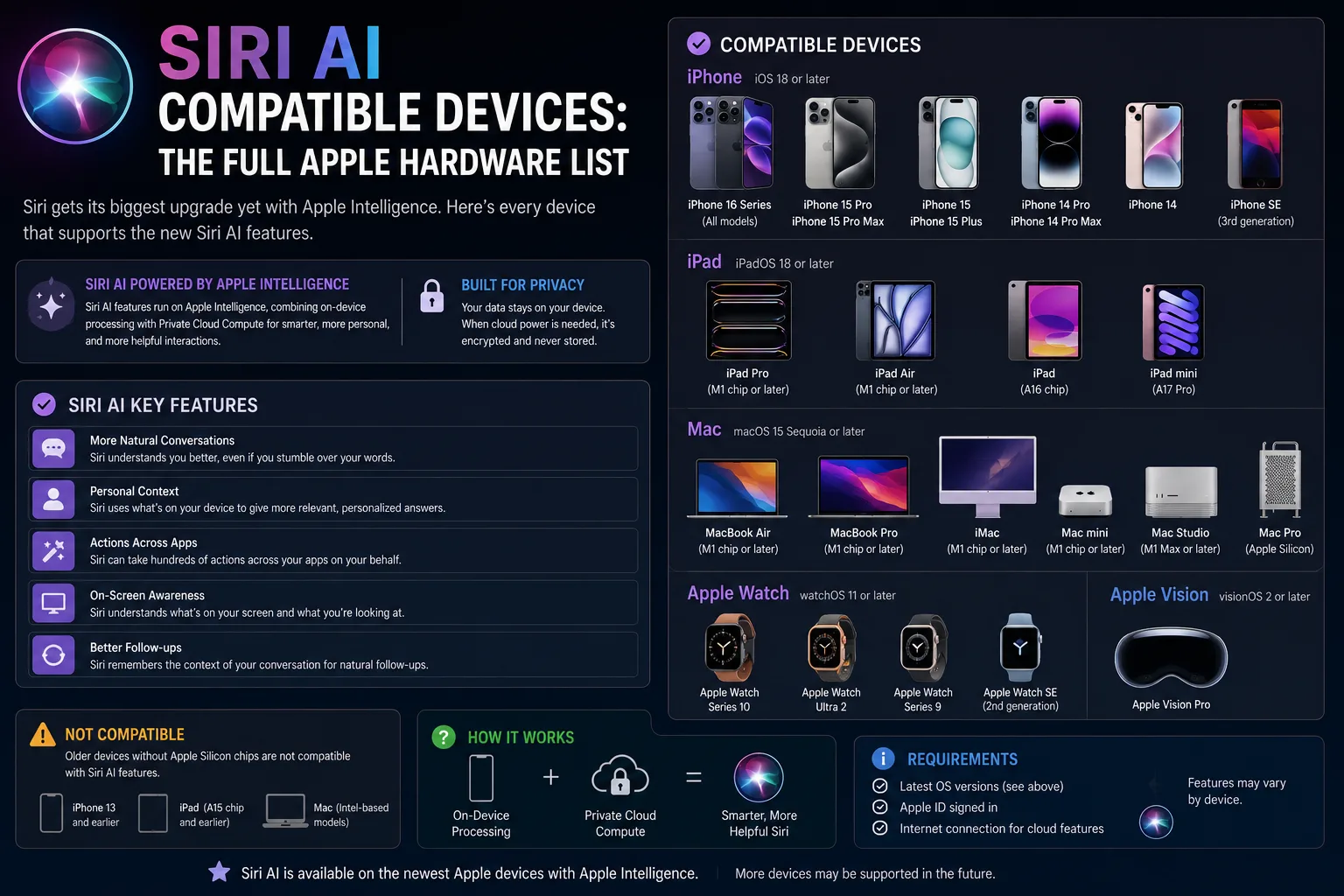
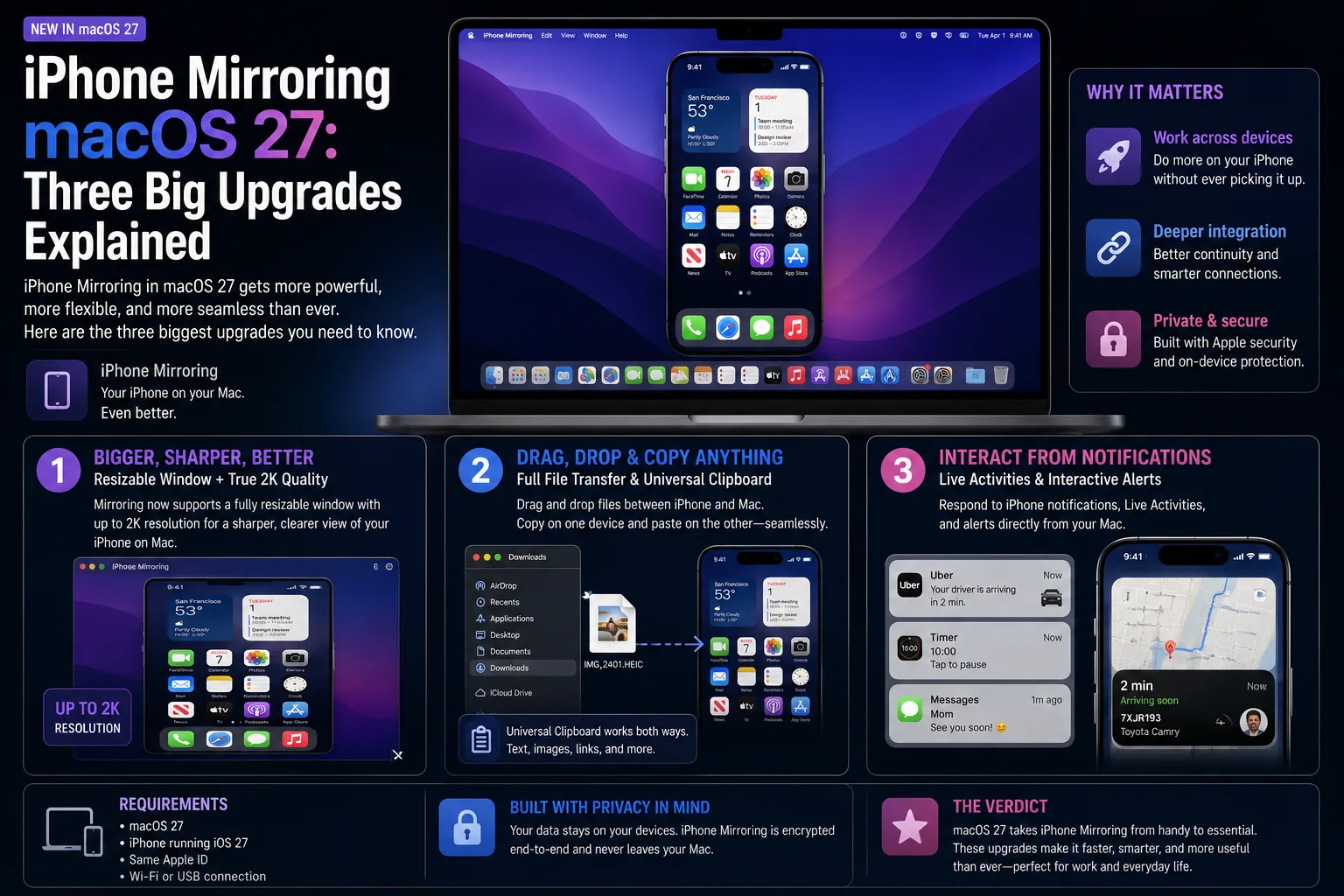
Apple is walking a similar path with Siri, so it is worth reading the other half of the story: our guide to Siri AI compatible devices covers which hardware makes the cut, and everything new in iOS 27 shows how Apple is rebuilding its own assistant around a model.
Google Assistant shutdown FAQ
When is Google Assistant shutting down?
Reporting points to September 2026, with 4 September attached to the Android phone rollout. Treat the exact date as provisional until Google confirms it, and expect a staged rollout across accounts.
Will my Google Assistant routines still work with Gemini?
Routines carry over to Gemini, but their behaviour can differ. Test the ones you depend on before the switch rather than discovering a change on a weekday morning.
Can I keep using Google Assistant instead of Gemini?
No. On affected devices Google is removing Assistant rather than leaving it as an option alongside Gemini, so there is no supported way to stay on the old assistant.
Does the shutdown affect Nest speakers and smart displays?
Not on the same timetable. Connected home devices are moving to Gemini on their own, slower rollout, so a kitchen speaker may change weeks after your phone does.
Is Gemini better than Google Assistant?
Gemini is better at conversation, context and open-ended questions. Assistant was faster and more predictable on short utility tasks such as timers and smart-home commands, so which one suits you depends on how you actually use voice.
Do I need a new phone when Google Assistant shuts down?
No. Gemini arrives as a software change on supported Android phones and Wear OS watches, so the switch itself does not require new hardware.
What happens to Google Assistant on Wear OS?
Wear OS watches are named in the shutdown reporting, so hands-free voice control moves to Gemini there too. Test dictation, timers and reminders on your watch before September.
Sources
- TechRadar — Android fans are rebelling against the imminent demise of Google Assistant
- Engadget — Google Assistant will vanish from Android phones and connected devices in September
- 9to5Google — Google Assistant shutting down on Android and Wear OS in September
- Ars Technica — Google plans to kill Assistant on your phone on September 4