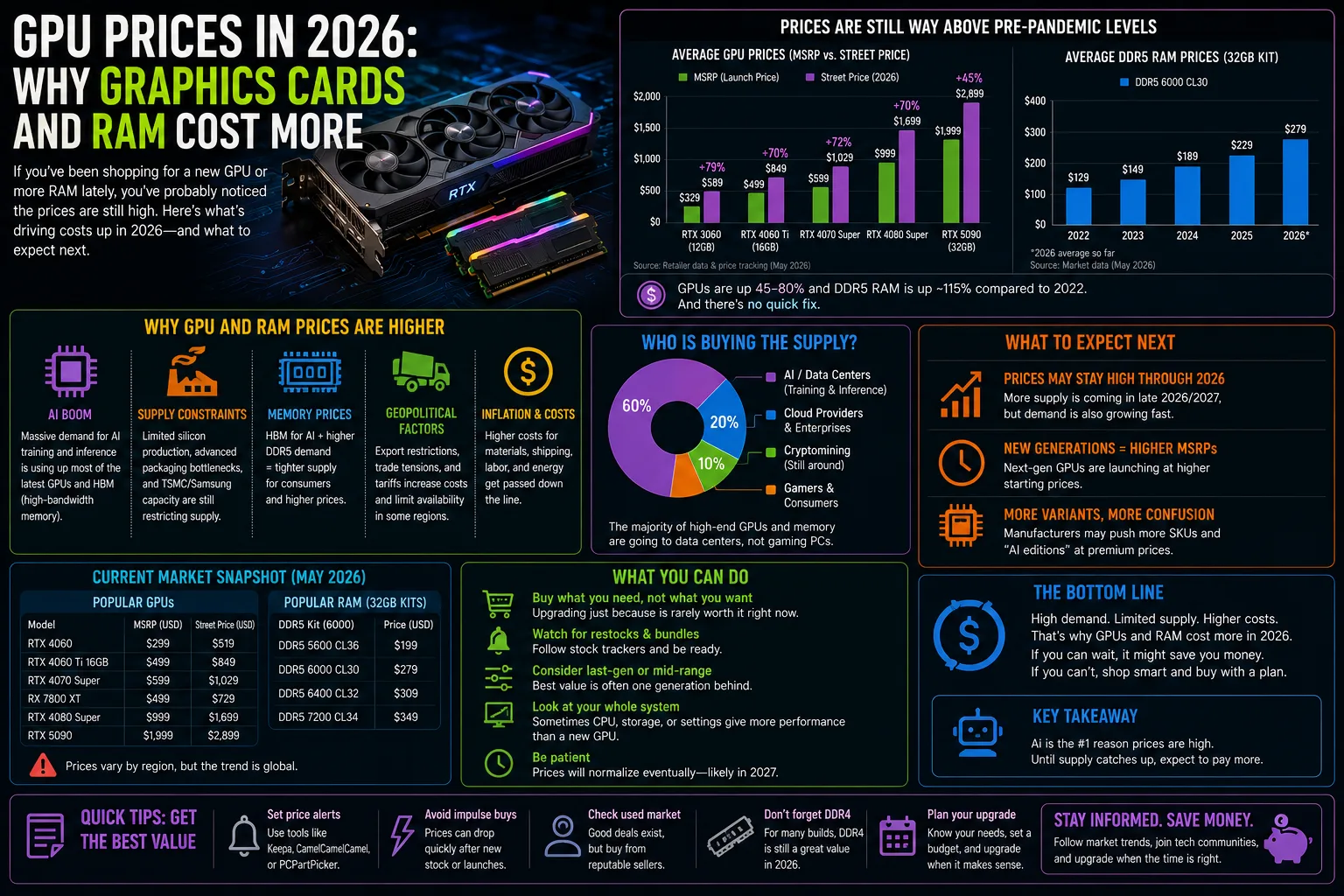
Graphics card prices are creeping up again in 2026, and gamers are not the reason. A worldwide DRAM shortage is lifting memory costs, pushing big PC brands toward unfamiliar suppliers, and dragging GPU pricing along with it. If you have a build or an upgrade pencilled in for this year, timing now matters almost as much as picking the right part.
What is driving the 2026 memory shortage?
The cause is supply, not consumer appetite. AI server buildouts have been absorbing an enormous slice of global DRAM production, and every wafer that becomes a data centre module is one that never becomes a desktop DIMM, a laptop stick, or the video memory soldered onto a graphics card.
TechRadar reported in early August 2026 that the squeeze has grown severe enough that major PC manufacturers, HP and Asus among them, are turning to CXMT — a Chinese DRAM maker — for chips they would previously have bought from Samsung or Micron. Large OEMs do not swap memory suppliers on a whim. Qualification cycles are long and warranty exposure is real, so a move like that usually signals that the preferred suppliers simply cannot deliver the volume at a workable price.
Why a DRAM shortage pushes graphics card prices up
A graphics card is far more than a GPU die. Every card carries its own pool of video memory, and that memory is a meaningful share of the bill of materials — often a bigger share than buyers assume on mid-range models. When memory contract prices rise, board partners have three moves available, and none of them work in your favour:
- Absorb the cost and run thinner margins, which they will only tolerate for so long.
- Quietly lift street pricing above the launch figure, which is the most common outcome.
- Trim allocation on high-VRAM versions and steer buyers toward smaller-capacity cards.
You normally notice the third one first. Stock on the generous-VRAM models thins out, discount codes stop working, and the sale price you remember from a few months ago simply never returns.
Which PC parts are hit hardest?
| Component | Exposure to the shortage | What to do |
|---|---|---|
| DDR5 system memory | High — priced directly off DRAM contracts | Buy the capacity you need now; skip 64GB unless you truly use it |
| Graphics cards | High — VRAM is a large slice of the build cost | Buy at or below normal street price, or hold |
| Laptops and prebuilts | Medium — makers hedge with long supply contracts | Compare against a DIY build; sometimes better value in a squeeze |
| SSDs | Medium — NAND is a separate market but shares fab capacity | Watch for slow drift rather than sudden spikes |
| Cases, coolers, PSUs | Low — no memory content at all | Buy these last, whenever it suits you |
The signals worth watching right now
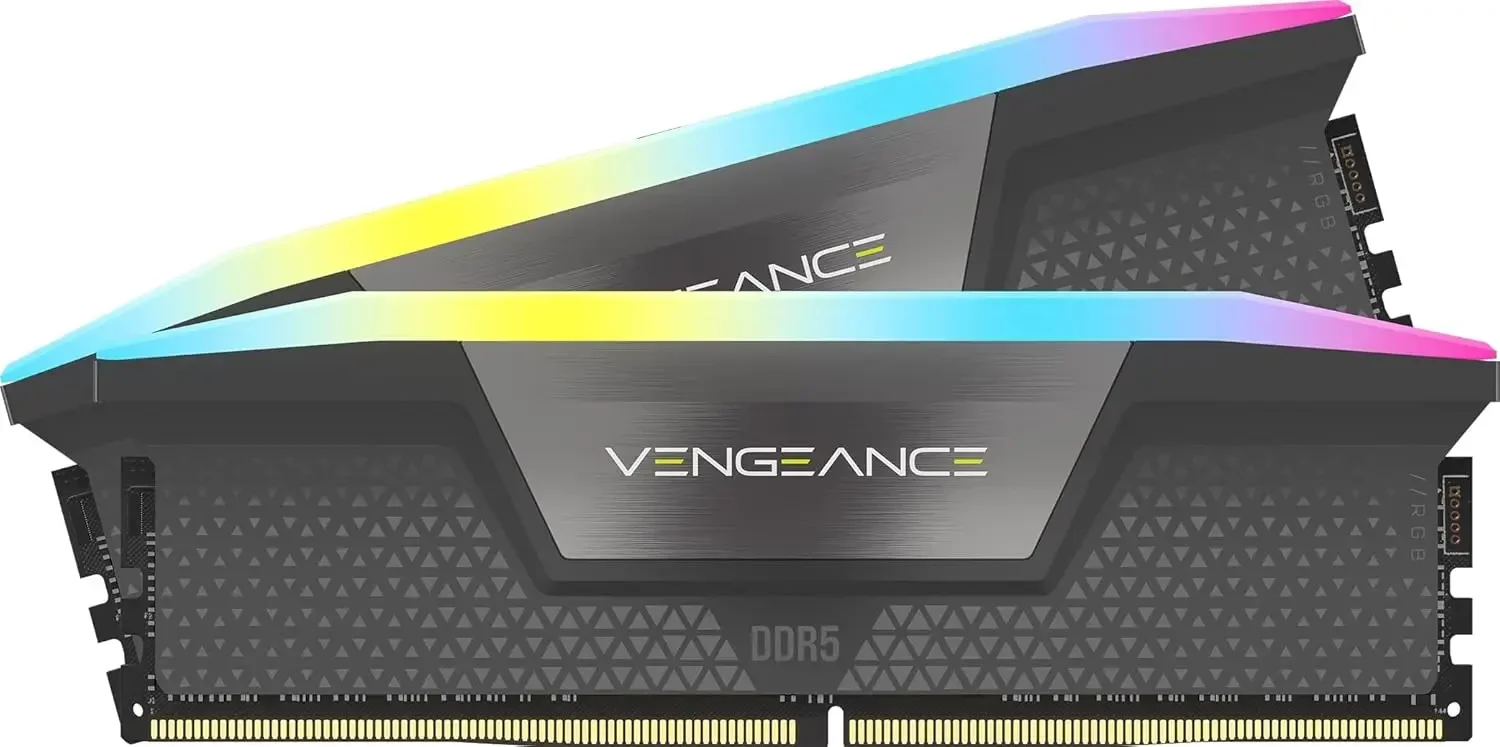
Several threads in the current news cycle point the same way. TechRadar's GPU coverage in August 2026 argued that graphics card pricing could climb again, and that buyers with a purchase already planned are better off moving early. Yet memory bargains have not vanished: Corsair's 32GB Vengeance RGB DDR5-6000 kit was discounted in the same window, which TechRadar framed as a rare win for builders. That mix is typical of the opening phase of a price rise — existing channel stock still clears at old pricing while replacement stock lands more expensive.
Should you buy a graphics card now or wait?
There is no universal answer, but the decision nearly always reduces to one question: do you actually need the part right now?
Buy now if
- Your current card is genuinely holding you back in the games or apps you use every week.
- The money is already set aside and the purchase was planned regardless of the news.
- You have found a card at or below its normal street price.
Waiting for a correction that may never arrive is how people end up paying more six months later. If you are still shortlisting, our roundup of the best graphics cards for 2026 covers the models that still make sense at today's prices.
Wait if
- Your existing hardware still handles what you play or create.
- You are only chasing a modest performance step.
- The card you want already sells well above its launch price.
Paying a shortage premium for a marginal gain is the worst version of this trade.
How to keep a 2026 PC build under control
- Buy memory and the GPU first. These two components are the most exposed to the shortage. Cases, coolers and power supplies are not, so they can wait.
- Set a ceiling you will not cross. Decide the number before you start browsing, then let stock alerts do the waiting for you.
- Look seriously at last-generation cards. A previous-gen GPU at a sane price beats a current-gen card at a panic price almost every time.
- Do not over-buy RAM. 32GB remains the sensible target for gaming and most creative work. 64GB is a niche requirement, and it is exactly where shortage pricing bites hardest.
- Price up laptops too. Prebuilt and laptop makers hedge with supply contracts, so a well-specced machine can occasionally beat the equivalent DIY build during a squeeze. Our gaming laptop deals roundup is a useful sanity check.
What could bring prices back down
Three indicators will tell you which way this goes. First, whether more OEMs publicly adopt CXMT or other second-tier suppliers, which would suggest the shortage is structural rather than seasonal. Second, whether Samsung and Micron commit added consumer-facing capacity. Third, whether GPU street prices climb above launch pricing across many retailers rather than one or two outliers. If all three move the wrong way, today's pricing is probably the floor for a while.
Until then the sensible posture is unglamorous: buy what you actually need, pay what you would have paid last year, and let the rest of the noise pass.
GPU and RAM price FAQ
Why are GPU prices going up in 2026?
A global DRAM shortage is the main driver. AI data centre demand is absorbing a large share of memory production, which raises the cost of the video memory fitted to every graphics card and tightens supply of higher-capacity models.
Should I buy a graphics card now or wait for prices to fall?
Buy now if your current card genuinely limits you and you can find one at or below normal street price. Wait if your hardware is still fine, or if the card you want already sells well above launch price, because you would be paying a shortage premium for a small gain.
How much RAM should I buy in 2026?
32GB of DDR5 remains the sensible target for gaming and most creative work. 64GB is a niche requirement and it is the capacity where shortage pricing bites hardest, so over-buying is an expensive way to future-proof right now.
What is CXMT and why does it matter?
CXMT is a Chinese DRAM manufacturer. TechRadar reported that large PC makers such as HP and Asus are turning to it for memory chips, which matters because big brands rarely switch suppliers unless their usual sources cannot meet demand at a workable price.
Will DDR5 prices come down later in 2026?
Only if supply loosens. Watch for Samsung or Micron adding consumer-facing capacity, and for OEMs stepping back from second-tier suppliers. Until one of those happens, expect prices to hold or drift upward.
Are laptops better value than a DIY build during a memory shortage?
Sometimes. Laptop and prebuilt makers buy memory on long-term contracts, so their pricing reacts more slowly than retail component pricing. It is worth comparing a well-specced laptop against the equivalent self-built PC before committing.
Does the shortage affect SSD prices too?
Indirectly. NAND flash is a separate market from DRAM, but the two compete for fabrication capacity and investment, so SSD pricing tends to drift rather than spike during a DRAM squeeze.
Sources
- TechRadar — Global memory shortage forces top PC makers to turn to CXMT chips
- TechRadar — GPU prices could climb again: expert advice on why you should buy now
- TechRadar — Corsair 32GB Vengeance RGB DDR5-6000 memory gets a big discount