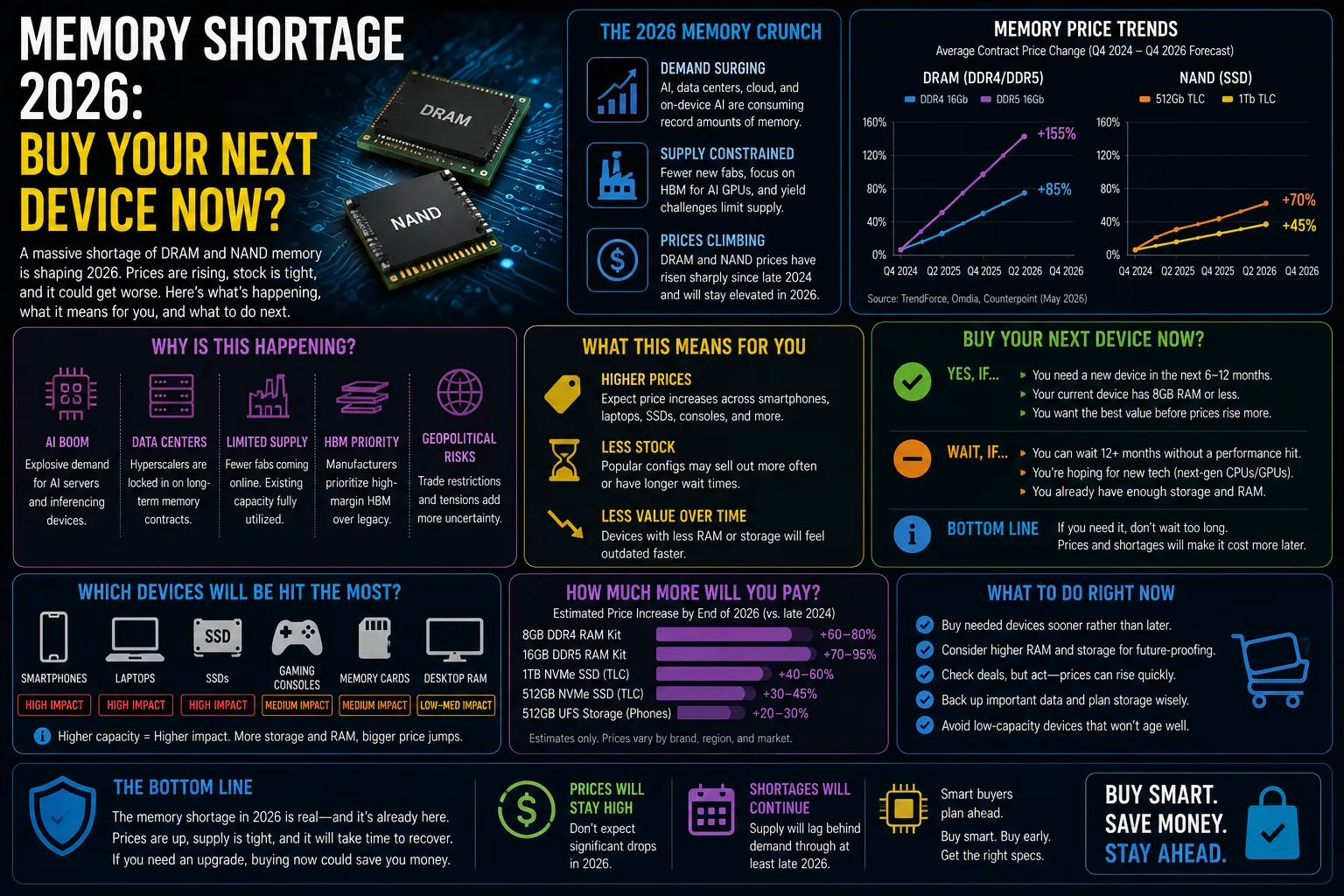
Apple is reportedly reducing planned 2026 hardware shipments because of a global memory shortage, and it is not alone — the same squeeze has pushed up RAM and storage prices, destabilised graphics card pricing and contributed to console price rises. If you were planning to buy a laptop, phone or tablet this year, the timing question suddenly has a real answer rather than a vague one.
Here is what is actually happening in the supply chain, which products it hits hardest, and how to time a purchase without gambling.
What the memory shortage actually is
Memory manufacturing capacity is finite, slow to expand, and currently being absorbed at extraordinary rates by AI data centre construction. High-bandwidth memory for AI accelerators is far more profitable per wafer than the conventional DRAM and NAND that goes into laptops and phones, so manufacturers have shifted production toward it.
The result is a supply squeeze in exactly the components every consumer device needs. Contract prices for memory have risen sharply, and because memory is one of the larger fixed costs in a laptop or phone bill of materials, that pressure eventually reaches retail prices — either as a higher sticker, or as a quieter reduction in what you get for the same money.
How this shows up in what you buy
| Product | Exposure to memory costs | Likely effect | Buying advice |
|---|---|---|---|
| Laptops | High | Higher prices or less base storage | Buy now if needed; over-spec storage |
| Phones | High | Base storage tiers squeezed | Buy the larger storage option |
| Graphics cards | Very high | Volatile pricing | Buy on availability, not on patience |
| Consoles | Moderate to high | Announced price rises | Buy before announced increases |
| Tablets | Moderate | Fewer discounts | Refurbished is good value |
| SSDs and RAM kits | Direct | Clear price increases | Buy upgrades early |
| Smart home devices | Low | Minimal | No urgency |
Should you buy now or wait?
- Your current device is failing or genuinely holding you back. Buy now. Waiting out a supply cycle while working on broken hardware is a false economy.
- You are buying within the next six months anyway. Buy at the earlier end. There is currently more evidence for prices rising than falling.
- You were planning to add RAM or an SSD to an existing machine. Do it now. Component upgrades are the most directly exposed to the shortage, and upgrading old hardware is much cheaper than replacing it.
- You are shopping for something optional and can wait a year or more. Wait. Shortages resolve as capacity comes online, and the current pricing is not permanent.
- You want a specific unreleased product. Waiting is your only option, but expect launch pricing to reflect component costs rather than undercut the outgoing model.
Buy the configuration you will still want in four years
This is the most useful concrete takeaway. When memory is expensive, manufacturers tend to keep headline prices stable by reducing base configurations — less storage, less RAM at the entry tier. And on most modern laptops and virtually all phones and tablets, neither is upgradeable after purchase.
That makes the storage and memory decision permanent. Paying for the larger tier once is nearly always cheaper than replacing the whole device in three years because 128GB filled up. If you must economise somewhere, economise on the processor tier rather than on memory or storage — you will notice a full disk far more often than a marginally slower chip.
Where the savings still are
- Refurbished, especially manufacturer-certified. Prices track the used market rather than new component costs, so the discount holds up better in a shortage. Our guide to whether Apple refurbished is worth it covers what that actually gets you.
- Last-generation new stock. Retailers clearing outgoing models often discount them below the new-generation entry price.
- Education and employer purchase programmes, which are frequently unaffected by short-term pricing moves.
- Upgrading rather than replacing. A new SSD in a five-year-old laptop transforms it for a fraction of replacement cost — buy the drive sooner rather than later.
- Waiting out a specific announced increase is not possible, but buying before one is. The Switch 2 price increase is a clear example of a dated deadline you can act on.
If your purchase is a desktop or a monitor rather than a portable machine, the calculus differs: graphics cards in 2026 are the most volatile category of all, while displays are relatively insulated — our look at 6K monitors covers where that money goes.
How much of this is confirmed
Be clear on the evidence. Memory price increases are documented and visible in component pricing. Reduced planned shipments at specific manufacturers come from supply chain reporting rather than company statements, so treat individual figures as unconfirmed. Apple has not published shipment plans, and analyst estimates in this area are frequently revised.
What you can act on is the direction, not the precision. Component costs are up, that pressure flows into finished goods, and configurations at the entry level are the first thing to quietly change.
Memory shortage buying FAQ
Why are memory prices rising in 2026?
Manufacturing capacity has shifted toward high-bandwidth memory for AI data centre hardware, which is more profitable than the conventional DRAM and NAND used in consumer devices, tightening supply.
Will laptop prices go up?
Memory is a significant share of a laptop's component cost, so sustained increases tend to reach retail either as higher prices or as reduced base storage and RAM at the same price.
Should I buy a laptop now or wait?
If you need one within six months, buy sooner. If your purchase is optional and you can wait a year or more, waiting is reasonable since shortages ease as capacity expands.
Is it worth buying RAM and SSDs now?
Yes, if you have an upgrade planned. Bare components are the most directly exposed to memory pricing, and upgrading existing hardware remains far cheaper than replacing it.
Which storage tier should I choose?
Buy more than you currently need. Storage is not upgradeable on most modern laptops, phones and tablets, so the decision is permanent for the life of the device.
Is Apple definitely cutting shipments?
This comes from supply chain reporting rather than an Apple announcement, so specific figures are unconfirmed and subject to revision. The broader component cost pressure is well documented.
Sources
- Memory market contract pricing reports
- Supply chain analyst reporting
- Ars Technica
- Tom's Hardware
- Reuters
- Retailer configuration and pricing listings